
Before You Can Broker a Single Load
The freight brokerage business is one of those industries where the barrier to entry seems low on the surface — you don’t need a warehouse, you don’t own trucks, you’re connecting shippers with carriers. But the federal government takes freight brokering seriously, and before you can legally operate as a freight broker in the United States, you have to clear a very specific regulatory hurdle with the FMCSA.
That hurdle is the freight broker bond.
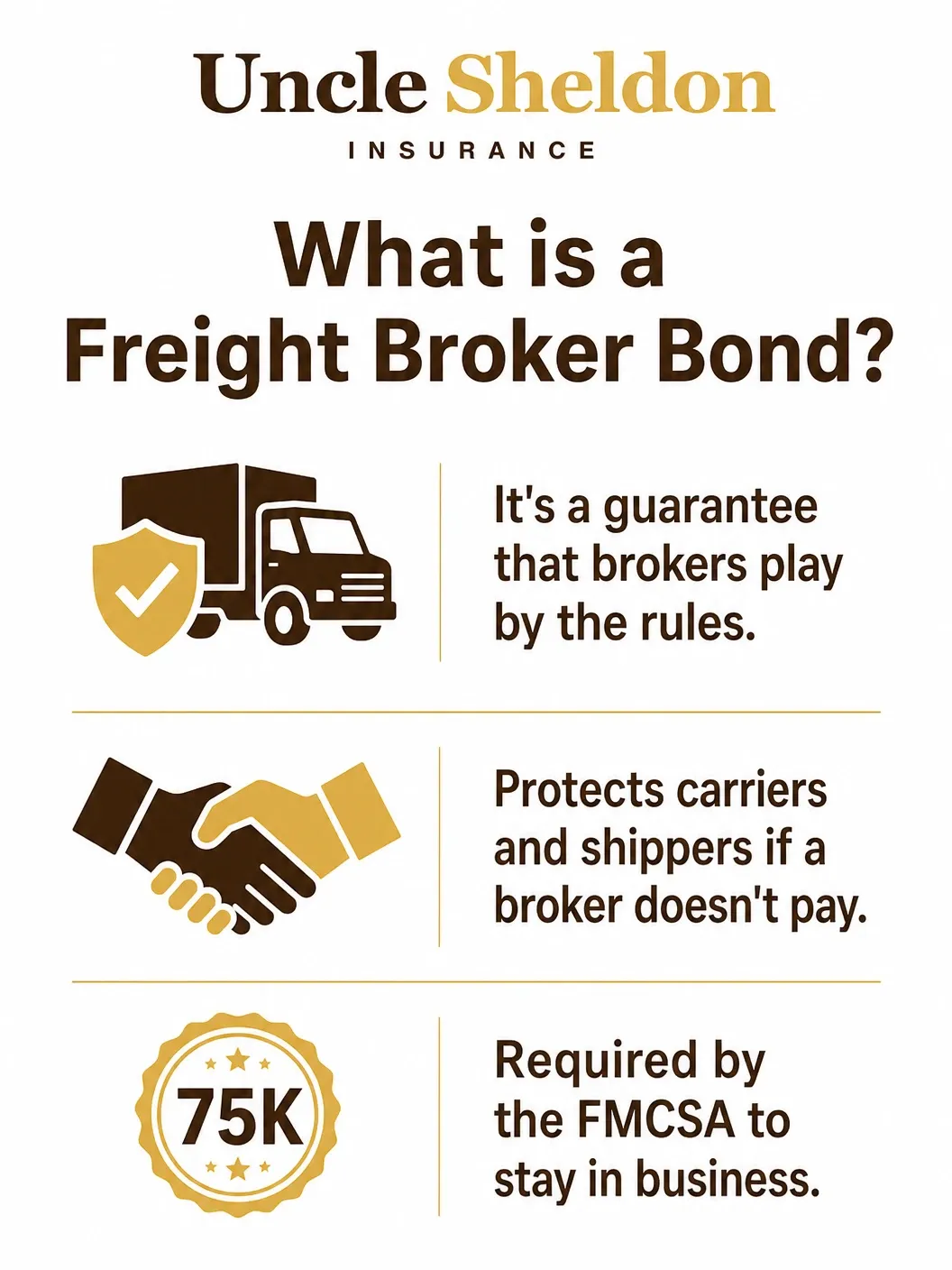
The Federal Motor Carrier Safety Administration requires every licensed freight broker to maintain a $75,000 surety bond or trust fund on file as a condition of holding operating authority. It’s not optional, it’s not a one-time fee, and you can’t get your broker license without it. If the bond lapses, your authority can be revoked. If it gets cancelled, you’ve got a narrow window to replace it before the FMCSA pulls your operating authority entirely.
A lot of people entering the freight business for the first time get a little confused about what the bond actually is and how it works. It’s not insurance in the traditional sense. It doesn’t protect your business directly. It exists to protect the carriers and shippers you work with. Understanding that distinction matters before you go shopping for one.
What a Freight Broker Bond Actually Is
A surety bond is a three-party agreement. You have the principal — that’s you, the freight broker. You have the obligee — that’s the FMCSA and the parties the bond protects. And you have the surety — the bonding company that issues the bond and backs it financially.
When you get bonded, the surety company is essentially vouching for you financially. They’re saying that if you fail to pay a carrier for a load you brokered, or if you fail to honor your financial obligations to a shipper, there’s $75,000 backing your promise. A harmed party can make a claim against the bond to recover what you owe them.
Here’s the part that catches a lot of new brokers off guard: if a claim is paid out on your bond, you’re on the hook to repay the surety company. The bond isn’t a policy that absorbs losses — it’s more like a line of credit that the surety extends on your behalf. If they pay someone out, they’re coming to you for reimbursement.
This is why your credit matters so much when getting bonded, and it’s why brokers with poor credit pay significantly higher premiums. The surety company is taking on financial risk based on the likelihood that you’ll run into trouble and that a claim will result. Better credit signals lower risk, and that shows up directly in your rate.
BMC-84 vs. BMC-85 — Two Paths to Compliance
The FMCSA gives freight brokers two ways to satisfy the $75,000 financial security requirement. Most brokers go one route, but both are legitimate options worth understanding.
The BMC-84 Surety Bond
The BMC-84 is a traditional surety bond, and it’s by far the most common way freight brokers fulfill this requirement. You apply through a surety company, they evaluate your credit and financial situation, they determine your premium rate, and you pay an annual premium to keep the bond in force.
The premium is a percentage of the $75,000 bond amount. You’re not paying $75,000 — you’re paying for the surety company to put that $75,000 on the line on your behalf. The annual cost varies based on your creditworthiness and the surety company you work with, but it’s significantly less than the full bond amount.
This is the route most freight brokers take because it doesn’t require tying up a large sum of cash. You pay the annual premium, the bond stays active, and you’re in compliance with FMCSA requirements.
The BMC-85 Trust Fund
The BMC-85 is an alternative to the surety bond. Instead of getting a bond through a surety company, the broker establishes a trust fund and deposits the full $75,000 with a federally insured financial institution. A trustee holds and administers the account according to FMCSA guidelines.
The tradeoff here is obvious. You actually have to put up $75,000 in cash and leave it sitting there. For a new broker just getting started, that’s a significant amount of capital to have locked up in a trust account and unavailable for business operations. On the flip side, there’s no annual premium — once the money is in the account, your ongoing cost to maintain compliance is just the trustee fees, which are typically modest.
| Option | How It Works | Upfront Cost | Ongoing Cost | Best For |
|---|---|---|---|---|
| BMC-84 Surety Bond | Surety company backs the $75,000; you pay annual premium | Low (first premium payment) | Annual premium (varies by credit) | Most brokers; preserves working capital |
| BMC-85 Trust Fund | You deposit $75,000 in a federally insured trust account | $75,000 in cash | Trustee fees (low) | Established brokers with strong cash reserves |
For the vast majority of freight brokers — especially those just starting out — the BMC-84 surety bond is the practical choice. Locking up $75,000 in a trust account when you’re trying to build a book of business is a tough ask. The annual bond premium is a much more manageable way to stay compliant.
The FMCSA Requirement — What You Actually Need to Know
The $75,000 bond requirement has been the law since 2013, when it was established under the Moving Ahead for Progress in the 21st Century Act, commonly called MAP-21. Before that, the requirement was $10,000. The increase was significant, and it was designed specifically to weed out undercapitalized brokers who were creating payment problems for carriers in the industry.
To legally broker freight in the United States, you need:
- A USDOT number
- Operating authority (MC number) from the FMCSA
- A $75,000 BMC-84 surety bond or BMC-85 trust fund on file with the FMCSA
- A designated process agent in each state where you operate (filed via the BOC-3 form)
The bond has to be continuous — meaning it can’t be a one-time filing and done. It has to stay active as long as you hold operating authority. If the bond is cancelled, the surety company is required to notify the FMCSA, and you have a window (typically 30 days) to replace it before your authority is revoked.
If you let your authority lapse and want to reinstate it later, you’ll need to go through the process again. This is why brokers who are active in the business treat the annual bond renewal as a non-negotiable item on their calendar.
What Determines Your Bond Cost
The premium you pay for a BMC-84 surety bond isn’t fixed. Different brokers pay different rates, and the variation can be meaningful. Here’s what surety companies are looking at when they evaluate your application.
Personal Credit Score
This is the single biggest factor for most smaller freight brokerages. Surety companies pull your personal credit, and your score directly influences the rate tier you fall into. Broadly speaking:
| Credit Range | Approximate Annual Premium |
|---|---|
| Excellent (720+) | $900 – $1,500 per year |
| Good (680–719) | $1,500 – $2,500 per year |
| Fair (620–679) | $2,500 – $3,750 per year |
| Poor (below 620) | $3,750 – $7,500+ per year (if bondable) |
These are rough ranges — actual rates vary by surety company, market conditions, and other factors specific to your situation. But the pattern holds across the industry. Strong credit means better rates. Poor credit means higher premiums, and in some cases, certain surety companies may decline to write the bond at all if the credit profile is considered too risky.
The good news is that as a broker, improving your personal credit over time can reduce what you pay for your bond at renewal. It’s worth keeping in mind.
Business Financials and Time in Business
If you’ve been operating as a freight broker for several years and you have solid business financials, surety companies look at that favorably. A track record of successful operations and financial stability offsets some of the credit risk. Brand new brokers with no track record are evaluated primarily on personal credit because there’s no business history to reference.
Prior Bond Claims
If you’ve had a claim made against a surety bond in the past, that follows you. Surety companies share claims information, and a prior claim is a significant red flag. It can make bonding harder to get and more expensive, and in some cases may make certain sureties unwilling to write you a bond at all.
The Surety Company You Work With
Not all surety companies price freight broker bonds the same way. Some are more competitive at certain credit tiers than others. Some specialize in transportation bonds and have more appetite for it. Working with someone who has access to multiple surety markets rather than just one company means you can actually shop the rate rather than just accepting whatever one company offers.
Continuous Compliance — What Happens If the Bond Lapses
This is something that trips up freight brokers more often than it should. The bond has to stay active continuously. There’s no grace period built into the system for letting it slide.
When a surety bond is cancelled — whether because you stopped paying the premium, because the surety dropped you, or for any other reason — the surety is required to notify the FMCSA. That triggers a countdown. You typically have 30 days from the cancellation notice to file a replacement bond. If you don’t, the FMCSA will revoke your operating authority.
Getting your authority revoked is a much bigger problem than just scrambling to find a new bond. You can’t broker legally while your authority is revoked, and reinstating it takes time and paperwork. Any loads you’d been moving have to be handed off or delayed. For an active brokerage, even a short period without operating authority can create real problems with carriers and shippers you’ve built relationships with.
The practical lesson here is to treat your annual bond renewal the same way you treat renewing your business license. Set a reminder. Don’t wait until you get a cancellation notice to deal with it.
When Claims Happen — Understanding the Process
Claims against freight broker bonds aren’t common, but they happen. The most typical scenario is a carrier that wasn’t paid for a load they hauled under a broker’s arrangement. If the broker doesn’t make the carrier whole, the carrier can make a claim against the bond.
The process generally looks like this: the carrier (or shipper) submits a claim to the surety company with documentation of what’s owed. The surety investigates. If the claim is valid, the surety pays out up to $75,000 to the claimant. The surety then pursues the broker to recover what was paid.
The $75,000 limit is a per-incident aggregate — it’s not replenished after a claim. If claims exhaust the full bond amount, the broker is in serious trouble from a compliance standpoint as well as a financial one. Most surety companies will cancel the bond if a significant claim is paid, which means the broker has to find new bonding — and that becomes very difficult after a claim history.
This is a big reason why the bond exists as a financial responsibility tool rather than just a licensing formality. It puts real stakes behind the broker’s obligation to pay carriers.
Freight Broker Bonds vs. Freight Broker Insurance
These are two different things and they often get lumped together, which creates confusion.
The bond is a FMCSA requirement — it’s about regulatory compliance and financial responsibility to the carriers and shippers you work with. It’s not optional.
Freight broker liability insurance, sometimes called contingent cargo liability or errors and omissions coverage, is a separate product that protects the broker’s own business in different scenarios. Contingent cargo coverage responds when cargo is damaged or lost and the carrier’s own insurance doesn’t fully cover the loss. E&O coverage for freight brokers responds to claims alleging errors in your brokering services.
You need the bond to be legal. The insurance products are there to protect your business. They work side by side — one doesn’t substitute for the other.
| Protection | What It Does | Required? |
|---|---|---|
| BMC-84 / BMC-85 Bond | Protects carriers and shippers; FMCSA compliance | Yes — mandatory |
| Contingent Cargo Liability | Covers cargo loss/damage when carrier insurance falls short | No — but strongly advisable |
| E&O / Professional Liability | Covers broker errors and professional negligence claims | No — but advisable for active brokers |
| General Liability | Covers third-party bodily injury and property damage | No — but typically needed for any business |
Getting Licensed — The Full Picture
The bond is one piece of a multi-step process for getting your freight broker authority established. Here’s the overall flow for new brokers getting started from scratch:
Step 1 — Register for a USDOT number if you don’t already have one.
Step 2 — File Form OP-1 with the FMCSA to apply for broker operating authority (your MC number). There’s a FMCSA filing fee for this.
Step 3 — Get your BMC-84 surety bond in place and have the surety file it electronically with the FMCSA.
Step 4 — File your BOC-3 form designating process agents in every state where you’ll operate. This is typically handled through a process agent service.
Step 5 — Wait for your authority to become active. The FMCSA publishes a waiting period after the application to allow for any protests from existing carriers or brokers.
Once your authority is active and all filings are in order, you can start brokering loads legally. The bond has to be in good standing from that point forward to keep the authority active.
Things New Brokers Often Miss
A few things that come up regularly when people are going through this process for the first time:
The bond doesn’t protect you. It protects the carriers and shippers you work with. If you think you’re buying the bond for your own financial protection, you’re thinking about it backwards. Your own protection comes from the insurance products you carry, not the bond.
Credit matters more than people expect. If you have a rough credit history, you’re going to feel it in the bond premium. It won’t necessarily stop you from getting bonded, but you’ll pay more for it. Working on your credit before you apply can save you meaningful money.
The bond has to be filed with the FMCSA electronically. It’s not enough to just have a bond document in your files. The surety company submits the bond filing directly to the FMCSA. Make sure the company you work with handles that filing — don’t assume it happened if you haven’t confirmed it.
Shopping the bond makes sense. There are quite a few surety companies writing freight broker bonds, and their rates at any given credit tier aren’t identical. If you’re just going with the first quote you get, you might be leaving money on the table.
Renewal timing matters. Your bond renews annually. If your surety company sends a renewal notice and you don’t respond quickly, the bond can lapse. Add your bond renewal date to your calendar and treat it as a priority.
Real Agents Who Know Freight
From bonding to trucking insurance, Uncle Sheldon has been helping people in the transportation world navigate the insurance and bonding requirements that come with running a real business. We’re not an automated platform that spits out a quote without talking to anyone. We’re actual agents who understand the freight industry and can walk you through exactly what you need.
When it comes to freight broker bonds specifically, being independent matters. We’re not locked into one surety company. We can shop your application across multiple surety markets and find the rate that makes the most sense for your credit situation and business profile. For a broker who’s just starting out and trying to keep overhead low, that difference in annual premium can matter.
We can also help you think through the full picture beyond just the bond — contingent cargo coverage, general liability, professional liability for brokers, and any other coverage that belongs in your program. The goal is to make sure you’re legally compliant and actually protected, not just checking a box.
Give us a call or reach out online. We’re real people, and we’re happy to take the time to understand your situation and help you figure out the right path forward.