
High End Condo Insurance Made Easy
A lot of people assume condo insurance is basically the same as homeowners insurance, just for a smaller space. It’s not quite that simple. Condo insurance — technically called an HO-6 policy — is its own type of coverage designed specifically for the condo ownership structure. And honestly, understanding how it works can save you from some really unpleasant surprises down the road.
Here’s the fundamental thing to understand: when you own a condo, you don’t own the building. You own your unit. The homeowners association owns the building structure, the roof, the exterior walls, the common areas, the hallways, the lobby, the pool — all of that. They carry insurance for the building. You carry insurance for your unit and your stuff.
The problem is, where exactly the building coverage ends and your responsibility begins isn’t always clear. That line is determined by the HOA’s master policy, and not every master policy draws that line in the same place. This is where condo insurance gets more complicated than most people expect, and it’s worth understanding well before you need to file a claim.
How the HOA Master Policy Works
Your HOA carries a master insurance policy that covers the building and common areas. There are generally two types of master policies you’ll encounter, and which type your HOA has matters a lot to how you set up your own coverage.
Bare Walls In
A bare walls-in master policy covers the building structure — studs, the exterior, the roof — but stops at the unfinished interior surfaces of your unit. The drywall, the flooring, the cabinetry, the fixtures, the built-ins — all of that is your responsibility. Bare walls-in is the more common type and it means your HO-6 policy needs to cover your unit’s interior finishes.
All In (Also Called All Inclusive)
An all-in or all-inclusive master policy covers the building structure plus the original fixtures, finishes, and installations within individual units. If you have this type, the HOA’s policy covers things like flooring, cabinets, and built-in appliances as they were originally installed. Your personal improvements or upgrades above the original spec would still be your responsibility.
If you don’t know which type your HOA has, ask. Get a copy of the declarations page of the master policy. Your HOA is required to provide this and it tells you exactly what they cover and where their coverage stops. That document is the starting point for figuring out what your own policy needs to do.
What Your HO-6 Policy Covers
A standard condo insurance policy has several key coverage components. Here’s how each one works.
Dwelling Coverage (Building Property)
This is the coverage that protects the interior of your unit — the walls, flooring, cabinets, countertops, fixtures, and any improvements you’ve made. How much dwelling coverage you need depends heavily on that master policy question above. If your HOA has bare walls-in coverage, you need enough dwelling coverage to rebuild the entire interior of your unit from the studs in. That’s not a small number. In many markets, finishing out a condo interior properly can easily run $50,000 to $150,000 or more depending on the size and quality of the finishes.
If your HOA has all-in coverage, your dwelling coverage need is smaller — primarily covering improvements and upgrades you’ve made above the original spec.
Getting this number wrong — specifically, underinsuring it — is one of the most common mistakes condo owners make. If you file a claim and your dwelling coverage isn’t sufficient to cover the rebuild cost, you’re paying the difference out of pocket.
Personal Property Coverage
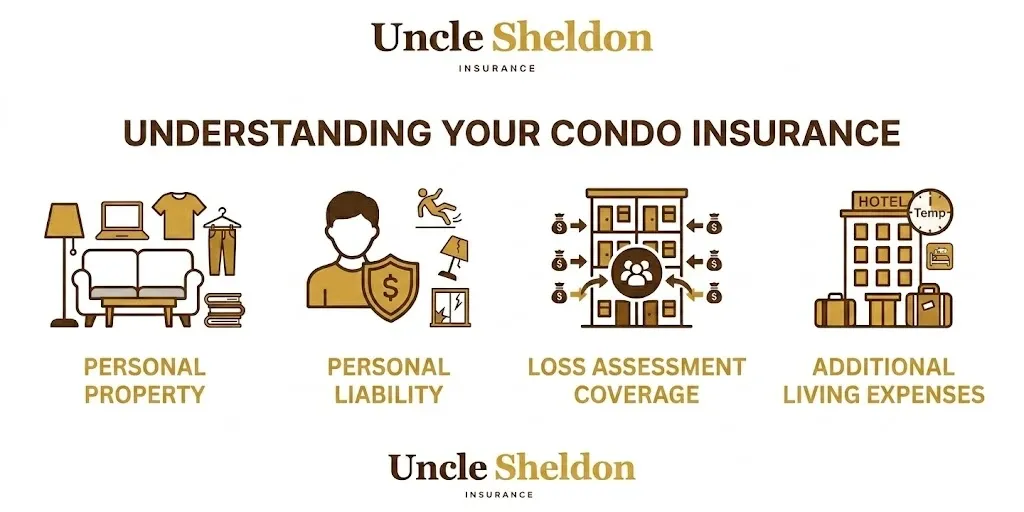
Personal property coverage protects your belongings inside the unit — furniture, electronics, clothing, kitchen stuff, sports equipment, everything you own. If there’s a fire, a burst pipe, a theft, or another covered event, personal property coverage reimburses you for your damaged or stolen items up to your policy limit.
The standard is replacement cost coverage versus actual cash value coverage. Replacement cost pays to replace your stuff at today’s prices. Actual cash value pays what the items are worth today, accounting for depreciation. A five-year-old laptop under actual cash value coverage might only pay you a fraction of what it costs to replace it. Replacement cost coverage costs a bit more but it’s usually the better choice because you can actually replace what you lost.
High-value items — jewelry, watches, art, collectibles, musical instruments, firearms — may have sub-limits under a standard personal property policy. If you own items in these categories, you may need to schedule them separately to get full coverage.
Liability Coverage
Liability coverage on your condo policy protects you if someone is injured inside your unit or if you cause damage to someone else’s property or unit. If a guest trips and falls in your condo and sues you, your liability coverage pays for legal defense and any judgment up to your policy limit. If a pipe in your unit bursts and water damages the unit below you, your liability coverage can respond to that claim.
Most condo policies come with $100,000 in liability coverage as a starting point, but you can typically increase that to $300,000 or higher. Given how lawsuits work, $100,000 doesn’t go very far if someone is seriously injured. More is generally better here, and the cost to increase liability limits is usually pretty modest.
Loss of Use (Additional Living Expenses)
If your unit becomes uninhabitable because of a covered loss — fire, flooding from a burst pipe, storm damage — loss of use coverage pays for your additional living expenses while it’s being repaired. Hotel bills, temporary rental costs, meals if you’re without kitchen access — these can add up quickly, especially if repairs take weeks or months. Loss of use coverage is one of those things you really appreciate having when you need it.
Loss Assessment Coverage
This one is specific to condo ownership and a lot of condo owners don’t know about it. If a major loss hits the building or common areas and the cost exceeds the HOA’s insurance, the association can assess the individual unit owners for a share of the remaining cost. This is called a loss assessment.
It can happen from a variety of scenarios — a large liability judgment against the HOA, catastrophic damage to common areas that exhausts the master policy limits, or even a situation where the HOA’s policy has a large deductible that gets passed through to unit owners.
Loss assessment coverage on your HO-6 policy pays for these assessments up to your policy limit. The default amount on many policies is relatively low — $1,000 to $2,000 — and you may want to increase it. Some high-rise or luxury condo communities have master policy deductibles in the tens of thousands of dollars, and if a major claim comes through, individual unit owners could be assessed a significant amount.
A Look at the Main Coverages Side by Side
| Coverage Type | What It Protects | Things to Know |
|---|---|---|
| Dwelling | Interior walls, floors, fixtures, improvements | Amount depends on your HOA’s master policy type |
| Personal Property | Your furniture, electronics, clothing, belongings | Replacement cost vs. actual cash value matters |
| Liability | Injuries or damage you cause to others | Consider higher limits than the default |
| Loss of Use | Temporary housing costs if unit is uninhabitable | Often a percentage of your dwelling limit |
| Loss Assessment | HOA assessments passed to unit owners | Default limits are often too low — check yours |
| Medical Payments | Minor medical bills for guests injured on your property | Usually a small flat amount, doesn’t require a lawsuit |
What a Condo Policy Typically Does Not Cover
Understanding exclusions is just as important as understanding what’s covered. A few of the common ones:
Flooding
Standard condo insurance doesn’t cover flood damage — meaning water that comes in from outside, like storm surge, overflowing rivers, or heavy rain that floods the ground floor. If you’re in a flood zone or your building has any flood exposure, a separate flood insurance policy is the answer. Flood insurance is available through the National Flood Insurance Program or through private flood insurers.
Earthquake
Earthquake damage is excluded from standard condo policies in most cases. If you’re in an area with meaningful seismic risk — California, the Pacific Northwest, parts of the Midwest near the New Madrid Seismic Zone — earthquake coverage is worth looking at separately.
Wear and Tear
Normal wear and tear isn’t covered by any property insurance. If your floors get scratched up over the years or your appliances age out, that’s maintenance, not an insurance claim.
The Building Itself
Your HO-6 policy doesn’t cover the exterior building, the roof, or common areas. That’s the HOA’s policy. Where this gets messy is when there’s ambiguity about whether something was inside your unit or part of the building structure — which is why reading the master policy matters.
Your HOA’s Deductible
In some cases, if a loss originates in your unit and triggers a claim on the master policy, you may be responsible for the HOA’s deductible. Some master policies have deductibles in the tens of thousands of dollars, and the association may have language in their documents allowing them to collect that from the unit owner whose unit was the source of the loss. Your loss assessment coverage can help here, but you need to have enough of it.
Renting Out Your Condo
If you rent your condo out — whether long-term or short-term through something like Airbnb or VRBO — a standard HO-6 policy may not provide adequate coverage. Standard condo insurance is designed for owner-occupants, not for rental activity.
For long-term rentals, a landlord or dwelling fire policy is usually the right approach. For short-term rentals, it gets more complicated. Some insurance companies now offer endorsements or policies specifically for short-term rental activity, and some credit card companies and platforms offer limited coverage, but it’s inconsistent and often insufficient.
If you rent your condo out at all, talk to your agent about it specifically. Don’t assume your standard HO-6 covers rental situations — it often doesn’t, and a denied claim on a rental property when you thought you were covered is a painful lesson.
If You’re Financing Your Condo
If you have a mortgage on your condo, your lender will almost certainly require you to carry condo insurance. They want their collateral protected. Lenders typically require you to carry at least enough dwelling coverage to cover the loan amount, though ideally you’d be insuring to the actual replacement cost of the unit interior regardless of what the lender requires.
Your lender may also require specific coverage minimums for personal liability. Read your mortgage documents or ask your loan officer about the specific requirements so you can make sure your policy satisfies them.
How Much Condo Insurance Costs
The cost of condo insurance is generally quite reasonable compared to homeowners insurance, which makes sense because you’re insuring a unit rather than an entire structure and land. That said, pricing varies quite a bit based on:
- Where the condo is located (state, city, coastal vs. inland, flood zone)
- The value and size of your unit
- How much personal property coverage you carry
- Your claims history
- The deductible you choose
- Whether you add endorsements or scheduled items
A basic condo insurance policy in a lower-risk area can run well under $100 per month. In higher-risk markets — coastal Florida, for example — costs can be significantly higher. The best way to get a real number is to get quotes based on your specific unit and situation.
Choosing a higher deductible can lower your premium, but make sure you’re choosing a deductible you could actually pay if you had to file a claim. There’s no point saving $10 a month on your premium if your deductible is set so high you’d struggle to cover it.
Things Worth Looking at When You Buy
A few specifics that are worth talking through with your agent when you’re shopping for condo insurance:
How was the dwelling coverage amount determined? Make sure it’s based on an actual estimate of what it would cost to rebuild your unit’s interior, not just an arbitrary number.
Is personal property coverage on replacement cost or actual cash value? Push for replacement cost if you can.
What is the loss assessment limit on the policy? Know what it is and whether it’s adequate given your HOA’s deductible structure.
Are there any high-value items that need to be scheduled separately? Think through what you own before assuming everything is fully covered.
Does the policy cover water damage from a sudden and accidental pipe burst? This is one of the most common condo claims. Most standard policies do cover this but it’s worth confirming.
Are you planning to rent the unit? Tell your agent upfront if there’s any chance of rental activity.
What Your HOA Insurance Does Not Do For You
We want to be really clear about this because it’s where condo owners get into trouble. Your HOA’s master policy protects the building and the HOA — it does not protect you personally.
It does not cover your personal belongings. It does not cover your liability if someone is injured inside your unit. Depending on the policy type, it may not cover your interior finishes. It does not cover your additional living expenses if you have to temporarily live elsewhere after a covered loss. And it does not cover the gap if their policy limits run out after a major event.
Your HO-6 policy fills those gaps. That’s exactly what it’s designed to do. The two policies — the HOA’s master and your personal HO-6 — are meant to work together.
Comparing Quotes and Finding the Right Fit
As an independent agency, Uncle Sheldon isn’t tied to one insurance carrier. We can shop your condo insurance across multiple companies to find coverage that fits your situation and your budget. Condo insurance rates and coverage terms vary between carriers more than most people realize, and the company that’s cheapest isn’t always the one that’s going to handle your claim the way you’d want them to.
We also take the time to actually understand your situation — what type of master policy your HOA has, what you own, whether you’re financing the unit, whether there are any rental considerations. That context matters when we’re putting together the right coverage for you. We’re not just punching numbers into a system and spitting out the cheapest quote.
If you own a condo and want to make sure you have the right coverage in place — or if you’re buying one and need to get a policy set up before closing — give us a call or reach out online. We’ll work through it with you.