
Why Travel Insurance Matters for Your Group
Travel insurance is easy to put off. You book the flights, reserve the hotel, get excited about the trip, and the last thing anyone wants to do is think about what could go wrong. We get it. But things do happen. Flights get cancelled. People get sick at the worst time. Bags disappear. Accidents happen far from home.
That is where the right travel insurance can help. It is not about making the trip scary. It is about making sure one bad day does not turn into a massive bill.
Medical care outside the United States can be very expensive. A serious illness in another country, or a helicopter evacuation from a remote area, can cost tens of thousands of dollars. Sometimes more. Many regular health insurance plans have limited coverage outside the U.S., and Medicare or Medicaid generally will not cover international medical care. That is a big thing to understand before you go.
Trip cancellation matters too. A family vacation with flights, hotels, cruise deposits, and tours can easily have thousands of dollars tied up in non-refundable costs. If you have to cancel because of a covered reason, travel insurance can help protect that money.
Most trips go just fine. We hope yours does. But if something goes sideways, having a real plan in place is a lot better than trying to figure it out from an airport chair at midnight.
The Main Types of Travel Insurance Coverage
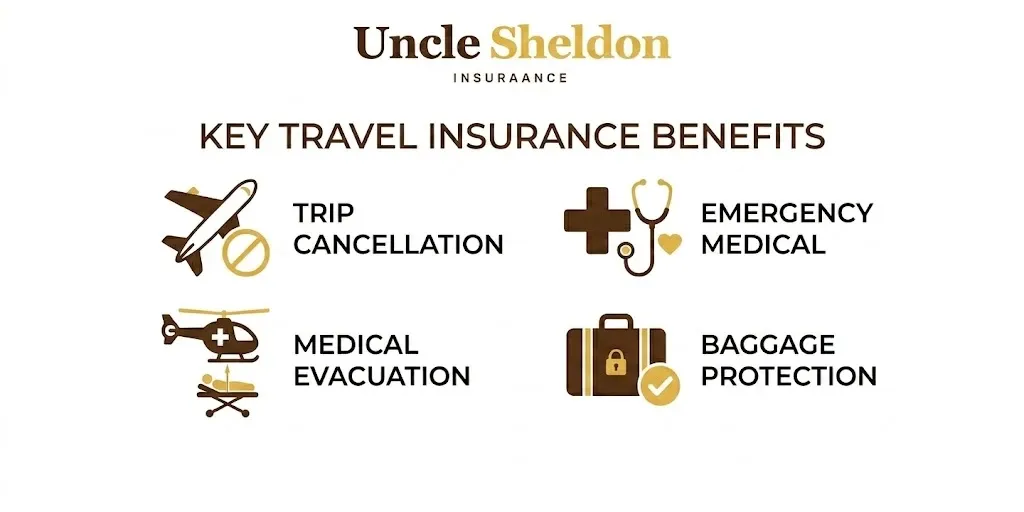
Travel insurance is not just one thing. Most policies are built out of several kinds of coverage, and each one does a different job. Here are the big pieces we usually explain to clients.
Trip Cancellation
Trip cancellation can reimburse prepaid, non-refundable travel expenses if you have to cancel before you leave for a covered reason. Every policy is a little different, but covered reasons often include things like:
- Unexpected illness or injury for you, a travel companion, or a close family member
- Death of a family member
- A natural disaster that makes the destination uninhabitable
- Jury duty or being subpoenaed
- Layoff or unexpected job loss
- A terrorist incident at the destination
The important part is this: the reason usually has to be listed in the policy. If you just decide not to go, standard trip cancellation usually will not pay. That is where Cancel For Any Reason coverage may come in.
Trip Interruption
Trip interruption applies after the trip has already started. If you have to cut the trip short and come home early for a covered reason, this coverage can help reimburse the unused part of the trip and the extra cost of getting home.
People overlook this one a lot. But if you are halfway through a three-week trip and a family emergency sends you home, that last-minute flight can be expensive. You may also lose the rest of your hotel or tour costs. Trip interruption is built for that kind of problem.
Travel Medical Insurance
This can be one of the most important parts of the policy, especially for international trips. Travel medical insurance helps pay for medical care while traveling, like doctor visits, hospital stays, surgery, medication, and emergency treatment.
Even countries with good healthcare systems do not usually give free care to visitors. And if you are in a place where the local medical care is limited, getting transported to proper care can add even more cost.
For travel inside the United States, your regular health insurance may do more of the work. Still, deductibles, out-of-network costs, and coverage limits can matter. It is worth checking before assuming you are fine.
Emergency Medical Evacuation
Emergency medical evacuation helps pay to move you to an appropriate medical facility if the care you need is not available where you are. That could mean an ambulance, helicopter, medical transport aircraft, or another kind of coordinated transport.
This is a big deal for cruises, adventure trips, ski trips, remote areas, and countries where medical access can vary. Evacuation costs can hit $50,000 to $100,000 or more depending on the situation. You do not want to be guessing about that coverage after something happens.
Baggage and Personal Effects
Baggage coverage can reimburse you if checked luggage is lost, stolen, or damaged. It can also cover certain personal belongings if they are stolen during the trip.
There are usually per-item limits and overall caps, so it is worth looking at the details. Expensive cameras, jewelry, sports gear, and electronics may not be covered the way people assume.
Airlines may have some responsibility for lost bags, especially on international flights, but the limits are not always enough and the claims process can be frustrating. Travel insurance can help fill some of that gap.
Baggage Delay
Baggage delay is different from lost baggage. If your bags are late and you need basics while you wait, like toiletries, clothes, or medication replacement, this coverage can reimburse those costs after the policy’s waiting period.
It sounds small until you land in another country and your suitcase is two days behind you. Then it suddenly feels very useful.
Travel Delay
Travel delay can reimburse reasonable extra expenses when your trip is delayed for a covered reason. That might include meals, lodging, transportation, or other costs while you wait.
Policies usually require the delay to last a certain number of hours before benefits start. Six or twelve hours is common, but it depends on the plan.
Cancel For Any Reason
Cancel For Any Reason, often called CFAR, is the flexible upgrade. It lets you cancel for reasons that are not listed in the regular policy and still recover part of your insured trip cost.
It usually does not reimburse 100 percent. Many CFAR benefits pay 50 to 75 percent of the insured trip cost. You also normally have to buy it soon after your first trip deposit and cancel at least a certain number of hours before departure.
CFAR is not needed for every trip. But for a very expensive trip, a trip with uncertain plans, or a situation where you just want more control, it can be worth talking about.
What’s Usually Covered and What’s Usually Not
| Generally Covered | Generally Not Covered |
|---|---|
| Illness or injury before or during the trip | Pre-existing conditions, unless waived |
| Death of a family member | Changing your mind without CFAR |
| Natural disaster at the destination | Pandemic or epidemic rules, which vary by policy |
| Airline-caused flight cancellation | Reckless or illegal activities |
| Lost or stolen luggage | War or civil unrest exclusions |
| Emergency medical care abroad | Some extreme adventure sports |
| Medical evacuation | Alcohol or drug-related incidents |
| Trip delay expenses | Financial default of a known supplier |
This table is only a general guide. Policies vary a lot. If you are unsure about a specific situation, that is exactly the type of question a real agent can help with.
Pre-Existing Medical Conditions
Pre-existing conditions are one of the biggest trouble spots in travel insurance. A lot of people assume their condition is covered because it is stable or because they feel healthy enough to travel. That is not always how the policy reads.
Most standard travel insurance policies have a pre-existing condition exclusion. The policy may look back a certain number of days before purchase, often 60 to 180 days, and claims tied to that condition may not be covered.
Many policies offer a pre-existing condition waiver, but timing matters. To qualify, you usually need to:
- Buy the policy within a certain window after your first trip deposit
- Be medically able to travel when you buy the policy
- Insure the full non-refundable cost of the trip
If you or someone traveling with you has a health concern, buy early and ask about the waiver. Waiting until right before the trip can close that door.
Single Trip vs Annual Travel Policies
If you take one big trip a year, a single-trip policy is usually the simplest option. You insure that trip, pay for that policy, and move on.
If you travel several times a year, an annual multi-trip policy may make more sense. These policies can cover multiple trips within a twelve-month period, usually with a limit on the length of each trip.
Annual policies can be convenient and sometimes less expensive for frequent travelers. They may also have different limits than a custom single-trip policy, so it is still worth comparing both.
How Much Travel Insurance Costs
Travel insurance cost depends on your age, the trip cost, trip length, destination, and the level of coverage you choose. Older travelers usually pay more because medical claim risk is higher.
As a rough range, a comprehensive single-trip policy often costs about 4 to 10 percent of the insured trip cost. A $5,000 trip might cost a few hundred dollars to insure. A larger cruise or international trip for an older traveler can cost more.
CFAR usually adds extra cost on top of the base premium.
The cheapest plan is not always the best deal. A low-cost policy with tiny medical limits or narrow cancellation reasons may save a little upfront but leave you stuck when you actually need help. We would rather help you understand what you are buying.
When to Buy Travel Insurance
Usually, the best time to buy is soon after your first trip deposit.
There are a few reasons. First, pre-existing condition waivers and CFAR often have early purchase windows. Miss the window and you may lose those options.
Second, trip cancellation coverage protects you from the date you buy the policy forward. If something becomes a known issue before you buy, it may not be covered later.
Buying early usually does not cost more than buying late. It just gives you more of the policy benefits when you need them.
Domestic vs International Travel
For travel inside the United States, the medical side may be less urgent if your regular health insurance follows you. But cancellation, interruption, baggage, and delay coverage can still be useful, especially if the trip is expensive or non-refundable.
Cruises from U.S. ports are a good example. Even if the cruise starts close to home, the refund schedule can get strict fast, and medical evacuation from a ship is a different issue altogether.
For international travel, medical and evacuation coverage becomes much more important. Your U.S. health insurance may not work well abroad, and in some places it may not work at all.
Adventure Travel and Specialty Coverage
Standard travel insurance may exclude certain higher-risk activities. Bungee jumping, skydiving, backcountry skiing, mountain climbing, scuba diving, motorcycle riding, and similar activities can be handled differently by each carrier.
If your trip includes adventure activities, tell your agent. Do not assume it is covered because it sounds like normal vacation fun. Some plans need an adventure sports rider or a specialty policy.
Uncle Sheldon also works with ski insurance as a specialty travel product. If you are taking a ski vacation, we can help look at coverage that fits that kind of trip.
Cruise Travel Insurance
Cruises deserve their own mention. The deposits can be large, cancellation penalties can get strict, and medical care on a ship is limited.
If something serious happens at sea, evacuation can be expensive. If you miss embarkation because of a delayed flight, you may have to pay a lot to catch up with the ship or change the trip. Port changes and itinerary disruptions can also create extra costs.
For cruises, we usually like to look at trip cancellation, trip interruption, missed connection, medical, and evacuation coverage together. A generic cheap plan may not be enough.
Filing a Claim
Travel insurance claims need documentation. It does not have to be perfect, but the more organized you are, the easier it usually goes.
- Keep receipts, invoices, and booking confirmations
- If you see a doctor, ask for a medical report and itemized bill
- For cancellations or interruptions, keep proof of the reason
- For lost or damaged bags, get the airline report before leaving the airport
- Report theft to local police and keep the report
- Save receipts for meals, hotels, transport, and other delay costs
The simple habit is this: document issues while they are happening. Trying to rebuild the story after you get home is where claims get messy.
Group and Family Travel Insurance
Many travel insurance policies can cover more than one traveler. For families, it can be easier to keep everyone on one policy. Some plans even include dependent children at no extra cost or at a reduced cost.
For larger groups, like destination weddings, corporate trips, or group tours, it may be worth looking at group travel insurance. The more people involved, the more important it is to get the coverage set up correctly.
Working With Uncle Sheldon on Travel Insurance
Uncle Sheldon is an independent insurance agency. We work with multiple carriers, which helps us compare options instead of forcing one company on every traveler.
When you reach out, we will ask about the trip. Where are you going? How long will you be gone? How much money is non-refundable? Are there health concerns? Are you skiing, cruising, diving, or doing something more involved?
From there, we can help you find the policy that fits. We explain it in plain language and we keep it human.
Work with a real agent, not a quote machine. If we can help you find the coverage you need, we will. If we cannot, we will try to point you toward someone who can.