
What a Business Owner Policy Actually Is
Most small and mid-sized businesses need at least two foundational types of coverage to operate responsibly — property insurance to protect their physical assets, and general liability insurance to protect them from third-party claims. Buying those separately works fine, but there’s a better way for a lot of businesses.
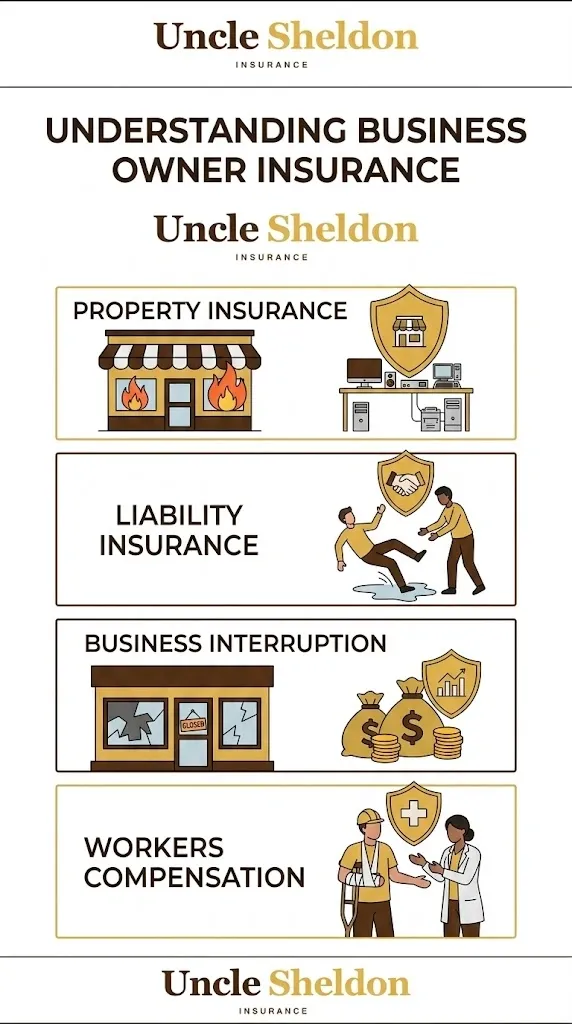
A Business Owner Policy, almost always just called a BOP, bundles commercial property and commercial general liability into a single package policy. It’s designed specifically for small to medium-sized businesses, and it typically costs less than what you’d pay if you bought those two coverages individually. It’s the most common starting point for a business insurance program, and for good reason.
The concept is pretty simple. The insurance industry recognized that small business owners have similar, predictable needs, and packaging those core coverages together made things easier and more affordable for everyone. Carriers can price it efficiently because they understand the risk profile of the types of businesses that qualify, and that efficiency gets passed along to the policyholder.
What you get with a BOP, in its most basic form, is protection for your business property — whatever that includes for your specific operation — and protection from claims made by third parties who allege your business caused them injury or damage. Both of those things in one policy, with one premium, one renewal date, and one carrier to deal with.
Who It’s Designed For
The BOP wasn’t built for every business. It’s designed for small to medium-sized businesses with a reasonably predictable, lower-risk profile. Not every industry or operation type qualifies for a standard BOP, and carriers have their own eligibility guidelines.
Businesses that commonly qualify for a BOP include:
- Retail stores and shops
- Offices and professional service firms (accountants, consultants, marketing agencies, financial planners)
- Small restaurants and cafes (though this varies significantly by carrier)
- Salons and spas
- Small contractors and service businesses
- Cleaning companies and janitorial services
- Technology firms and IT service providers
- Non-profit organizations
- Real estate offices and property management companies
- Small wholesale or distribution businesses
Businesses that typically don’t qualify for a standard BOP include larger operations, businesses with significant manufacturing exposure, bars and nightclubs, auto dealers, and certain high-hazard industries. For those, the coverage pieces need to be assembled individually rather than packaged.
The general guideline is that a BOP is built for businesses that are smaller in revenue and footprint, operate from a fixed location or a limited number of locations, and don’t have the kind of complex, specialized risk profile that needs individually tailored coverage across every line.
The Property Side of the Policy
Commercial property coverage in a BOP protects the physical assets your business depends on. Depending on whether you own or lease your space, that can mean very different things.
If you own the building, the property coverage can include the building itself — walls, roof, attached fixtures, permanent improvements, and the basic structure. Damage from fire, windstorm, hail, theft, vandalism, and a range of other named perils is typically covered.
If you lease your space, building coverage may not be relevant to you at all. What matters is your business personal property — the contents inside the space that belong to your business.
Business personal property is the broad category that covers the stuff inside. Furniture, equipment, inventory, tools, computers, shelving, display cases, machinery — anything you own that’s part of running the operation. For a lot of small businesses, this is the most important piece of the property coverage because without their equipment and inventory, they literally can’t operate.
Improvements and betterments is a category worth knowing about if you lease. If you’ve put money into improving a rented space — new flooring, a build-out, upgraded fixtures — those improvements become part of the property and can be covered even though you don’t own the building.
Replacement Cost vs. Actual Cash Value
How the policy values your property matters a lot, and it’s one of the first things to sort out when you’re reviewing a BOP.
Replacement cost coverage pays to repair or replace damaged property with new materials of similar kind and quality, without deducting for depreciation. If your five-year-old computer equipment gets destroyed in a fire, replacement cost coverage pays for new equipment of comparable type — not what the old stuff was worth today.
Actual cash value pays the current market value of the damaged property after factoring in age and depreciation. That same five-year-old computer equipment might be worth a fraction of its original cost on an ACV basis. You’d get a check for the depreciated value, and the gap between that and what it actually costs to replace the equipment comes out of your pocket.
Replacement cost is almost always the better option for businesses that depend on their equipment. The premium difference is usually not dramatic, and the difference in coverage when you have a claim can be significant.
| Valuation Method | How It Pays | Out-of-Pocket Risk |
|---|---|---|
| Replacement Cost | Full cost to replace with new, similar property | Low; minimal gap between payout and actual cost |
| Actual Cash Value | Depreciated market value at time of loss | Potentially significant; gap grows as property ages |
Business Interruption Coverage — The Piece Most People Underestimate
One of the most valuable elements built into most BOP policies is business interruption coverage, sometimes also called business income coverage. This is the part of the policy that keeps a business financially alive when a covered loss forces it to temporarily close.
Here’s how it works. A fire damages your retail store to the point where you can’t operate. The property coverage handles the physical damage — repairs to the building, replacement of destroyed inventory and equipment. But what about the income you’re not earning while the store is closed? What about your rent obligation that doesn’t stop just because you had a fire? What about your employees’ wages, your loan payments, your utilities — the ongoing expenses that continue even when revenue goes to zero?
Business interruption coverage fills that gap. It replaces the income your business would have earned during the closure period, up to the policy limits, and covers your continuing normal operating expenses during the same period.
The coverage period is important to understand. Most business interruption coverage applies for the time reasonably required to repair or replace the damaged property and restore operations — the “period of restoration.” That’s not unlimited time, but it should cover the actual recovery period if the coverage limits are set appropriately.
Extra expense coverage, which often comes alongside business interruption, covers additional costs you incur to keep operating or speed up the recovery — like renting a temporary space, renting equipment, or paying for rush repairs to get back up faster. It’s a practical coverage that makes a real difference when you’re trying to minimize the damage a loss does to your business relationships and revenue.
A common mistake small business owners make is not buying enough business interruption coverage. The default limits in some BOPs may not reflect what your business actually earns. If your business brings in $500,000 a year and you have $150,000 in business income coverage, a six-month closure could leave you in serious financial trouble despite having a policy. When we review a BOP with a client, the business income limit is always one of the first things we look closely at.
The Liability Side of the Policy
The general liability component of a BOP is functionally the same as a standalone commercial general liability policy. It protects the business from third-party claims involving:
Bodily injury — Someone is injured as a result of your business operations. A customer slips on a wet floor in your shop. A visitor trips over equipment at your office. An injury happens at a job site. The liability coverage handles medical costs, legal defense if a lawsuit follows, and any damages awarded.
Property damage — Your business operations cause damage to someone else’s property. A contractor accidentally damages a client’s flooring. A cleaning crew breaks something at a customer’s home. The liability coverage responds.
Personal and advertising injury — Less obvious but genuinely important. This covers specific non-physical harms like libel, slander, copyright infringement in advertising, and similar claims. If a competitor alleges your marketing materials infringe on their copyright, or someone claims your business made defamatory statements about them, personal and advertising injury coverage is what responds.
Medical payments — A no-fault coverage that pays for minor injuries on your premises or from your operations without requiring a lawsuit. Low limits, typically a few thousand dollars per person, but it helps resolve small incidents quickly before they escalate.
The liability component pays for legal defense even if the claim against you has no merit. That matters because defending a frivolous lawsuit still costs money, and legal fees can get expensive fast even when you’re in the right.
Common Liability Limits for Small Businesses
| Limit Type | Common Configuration | What It Means |
|---|---|---|
| Per Occurrence | $1,000,000 | Max paid for any single claim |
| General Aggregate | $2,000,000 | Max paid for all claims in the policy year |
| Products / Completed Operations Aggregate | $2,000,000 | Sub-limit for product or completed-work claims |
| Personal & Advertising Injury | $1,000,000 | Per-occurrence limit for those specific claims |
| Medical Payments | $5,000–$10,000 per person | No-fault minor injury coverage |
Higher limits are available and sometimes appropriate depending on the industry, the size of contracts you’re working on, or client requirements. A commercial umbrella policy is how many businesses stack additional liability coverage above these primary BOP limits.
What a BOP Does Not Cover
Understanding what the BOP leaves out is just as important as knowing what’s in it. Several major coverage categories are specifically excluded from a standard business owner policy and need to be purchased separately.
Professional Liability / Errors and Omissions — If a client sues you over the quality of your professional services or advice — an accountant who files taxes incorrectly, a consultant whose recommendation caused financial harm, a web developer whose code had a critical flaw — that’s a professional liability claim. A BOP general liability policy specifically excludes professional services claims. Professionals who give advice or expertise for a living need a separate E&O policy.
Commercial Auto — Vehicle accidents aren’t covered under a BOP. If you or your employees drive vehicles for business purposes and an accident occurs, that’s a commercial auto claim. The BOP doesn’t respond to it. This is true whether you own the vehicles through the business or whether employees use personal vehicles for work (hired and non-owned auto coverage addresses the latter).
Workers Compensation — Employee injuries on the job are handled through workers compensation insurance, which is separate from a BOP and required by law in most states. A BOP covers third-party injuries — customers, visitors, the public — not injuries to your own employees.
Employment Practices Liability — Claims from employees alleging discrimination, harassment, wrongful termination, or similar employment-related issues require a separate employment practices liability policy (EPLI). The BOP doesn’t cover these situations.
Flood and Earthquake — Standard commercial property coverage in a BOP excludes flood and earthquake. If your business is in a flood-prone area or an earthquake zone, separate coverage is needed for those specific perils.
Cyber Liability — Data breaches, ransomware, and cyber incidents generally aren’t covered under a standard BOP. Some carriers offer a cyber liability endorsement that can be added to a BOP, but the coverage is usually limited. Businesses that collect customer data, process payments, or rely heavily on digital systems usually need a standalone cyber liability policy for adequate protection.
Key Person or Life Insurance — The BOP doesn’t replace the income or value of a key employee or business owner in the event of death or disability. Those are separate life and disability insurance products.
| Coverage | Included in BOP? | Where to Get It |
|---|---|---|
| Commercial property | Yes | Core BOP coverage |
| General liability | Yes | Core BOP coverage |
| Business interruption | Yes (usually) | Core BOP coverage |
| Professional liability / E&O | No | Standalone E&O policy |
| Commercial auto | No | Separate commercial auto policy |
| Workers compensation | No | Separate workers comp policy |
| Employment practices liability | No | Standalone EPLI policy |
| Cyber liability | Limited / endorsement only | Standalone cyber policy |
| Flood | No | NFIP or private flood policy |
| Earthquake | No | Separate earthquake endorsement or policy |
Optional Add-Ons and Endorsements
Most BOPs can be expanded beyond the base coverage with endorsements — specific additions that address risks not covered in the standard policy. Common BOP endorsements include:
Equipment breakdown — Covers damage to mechanical and electrical equipment from internal causes like motor burnout, electrical arcing, or pressure vessel rupture. Standard property coverage handles external events (fire, theft) but not equipment that just breaks down on its own. For businesses that depend on machinery, refrigeration, HVAC systems, or specialized equipment, this matters.
Data breach / Cyber — A basic cyber endorsement can be added to some BOPs to cover limited breach-related costs. It’s better than nothing but usually has lower limits than a standalone cyber policy.
Hired and non-owned auto — Covers liability that arises when employees use their personal vehicles for business errands or when the business rents vehicles. It doesn’t cover damage to those vehicles — just the liability exposure.
Employee dishonesty / Crime — Covers theft or dishonest acts by employees. If an employee steals from you, standard property coverage generally doesn’t cover it. A crime or employee dishonesty endorsement does.
Outdoor signs — Property coverage sometimes has sublimits or exclusions for signage. If your business has significant exterior signage, an endorsement can make sure it’s adequately covered.
Spoilage — For businesses that depend on refrigerated inventory — restaurants, grocery stores, food distributors — spoilage coverage pays for perishable goods lost due to equipment breakdown or power failure.
What Drives the Cost of a BOP
BOP premiums vary quite a bit from business to business. Several factors go into how underwriters price a commercial policy:
Type of business and industry — A low-foot-traffic accounting office is priced very differently than a restaurant with hundreds of customers coming through the door daily. Industry risk classification is one of the first things underwriters look at.
Revenue and size of the business — General liability premiums are often tied to revenue. Larger businesses with more activity have more exposure, and premiums reflect that.
Value of business property — The more your equipment, inventory, and building are worth, the more property coverage costs.
Location — Claims frequency and severity vary by geography. A business in an area with higher crime rates or severe weather exposure may pay more for property coverage. State litigation environments affect liability pricing.
Claims history — A clean claims history is a positive factor. Prior claims, especially multiple or large ones, push premiums up and can limit carrier options.
Coverage limits and deductibles — Higher limits cost more. Higher deductibles lower the premium but shift more risk to the business.
Number of locations — Multi-location businesses generally pay more because there’s more exposure to cover.
For a lot of small businesses — a small office, a retail shop, a service company — a BOP might run anywhere from a few hundred to a couple thousand dollars per year for basic coverage. Higher-risk businesses, those with significant property values, and those with prior claims will pay more. The only real way to know is to get actual quotes for your specific situation.
Common Mistakes Small Business Owners Make
We see the same mistakes come up regularly when talking with business owners about their coverage. Worth going through a few of them.
Buying the minimum and hoping for the best. Some business owners buy the cheapest BOP they can find, with the lowest limits available, just to say they have coverage. When a real claim happens, the limits run out and they’re paying the rest personally. Getting the right limits matters more than saving a small amount on the annual premium.
Not buying enough business income coverage. As mentioned earlier, the default business interruption limits in some BOPs don’t reflect what the business actually earns. If you had to close for three or four months, would your policy actually replace your income? Run the numbers, not the defaults.
Assuming the BOP covers everything. The exclusions in a BOP are significant. Professional services businesses especially run into trouble when they assume general liability covers client disputes about their work. It doesn’t. The E&O gap is real.
Skipping the professional liability conversation. If your business involves giving any kind of advice, designing something, providing a professional service, or holding licenses — you almost certainly need E&O coverage in addition to the BOP. General liability and professional liability address completely different categories of risk.
Not reviewing the policy at renewal. Your business changes. Revenue goes up, you add employees, you move locations, you start offering new services, you buy new equipment. A policy that fit your business three years ago might have real gaps today. Annual reviews aren’t just a formality.
Under-insuring business property. Property insurance works best when it actually reflects the value of what you own. If you insure $50,000 in equipment and you really have $150,000 worth, you’re going to have a problem when you file a claim. Most commercial property policies have coinsurance provisions that can reduce your payout if your coverage amount is significantly below the actual value of the property.
Building a Complete Business Insurance Program
The BOP is the foundation — the core coverage that most small businesses start with. But for most businesses, it’s not the complete picture. A thoughtfully built business insurance program usually involves the BOP plus whatever additional policies address the specific risks that apply.
That might look like:
A BOP for the core property and liability. A professional liability policy if you provide services or advice. A commercial auto policy if vehicles are involved in the business. Workers compensation if you have employees. A commercial umbrella to extend your liability limits above the BOP. And cyber liability if you handle customer data or process payments digitally.
The right combination depends entirely on what your business does, who you work with, what you own, and what your contractual and regulatory obligations are. None of these policies substitute for the others — they each address different exposures.
Shopping Your BOP the Independent Way
Uncle Sheldon is an independent agency, and that matters when you’re shopping for a BOP because we’re not tied to any single carrier. We work with multiple companies, and we can actually shop your business across the market to find the combination of price and coverage that fits what you’re doing.
We also take the time to understand your business before we start talking about coverage. What you do, how you do it, where you’re located, how big you are, what you own, who your customers are — all of that goes into building a policy program that actually makes sense rather than just checking a box.
If you’re starting a new business and trying to figure out what you need, we can help you work through it from scratch. If you’ve been in business for a while and you’re not totally sure what you have or whether it’s still right for where you are today, that’s worth a conversation too. We’ll give it to you straight, and we’re not trying to sell you something you don’t need.
Give us a call or reach out online. We’re real people and we’re happy to talk through it with you.