
Your Home, the Whole Picture
Uncle Sheldon is a concierge insurance agency helping find insurance for higher-value homes and harder-to-place home risks. Think shore properties, mountain and resort homes, and the kind of house that doesn’t fit neatly into a standard carrier’s box.
We look at how your home coverage fits with everything else, your umbrella, any short-term rental or business use, so a gap in one doesn’t turn into a surprise in another. And when a claim happens, we don’t disappear. We help you file it, track it, and push back if the carrier’s first offer doesn’t reflect what a home like yours actually costs to rebuild.
Standard market carriers often decline these homes outright or price the risk badly. That’s where our access to excess and specialty markets does the real work, finding a carrier that actually wants a property like yours instead of one that’s just tolerating it.
Why Home Insurance Matters More Than Most People Think
A lot of homeowners treat their insurance policy like a bill to pay and a document to file away. They know they need it — usually because the mortgage lender requires it — but they don’t really know what’s in it or whether it’s actually set up right. That’s where things can go sideways.
Home insurance isn’t complicated once you understand the building blocks. But the coverage decisions you make when you set up the policy have real consequences when you file a claim. Underinsuring your home, missing key coverage, or having the wrong deductible structure can mean you get a check that doesn’t come close to covering your actual loss.
At Uncle Sheldon, we’re here to make sure you actually understand what you’re buying. Not just a quote — an explanation of what it does and how it works for your specific house and situation.
The Main Coverage Sections in a Homeowners Policy
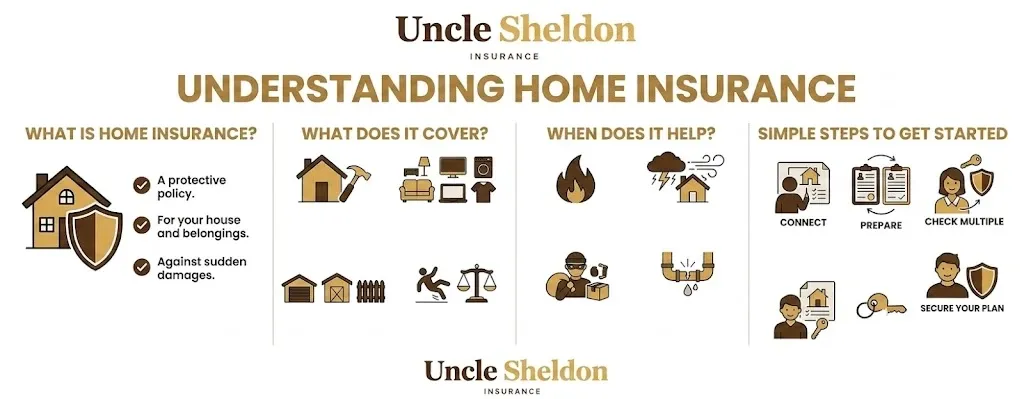
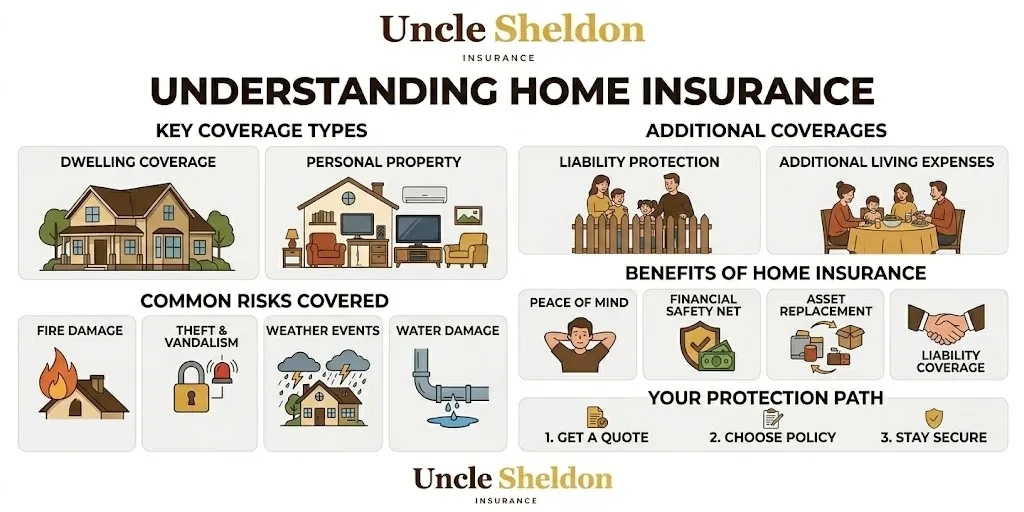
A standard homeowners policy — most commonly an HO-3 form — is made up of several distinct coverage parts. Understanding each one helps you know what you have and where the gaps might be.
Dwelling Coverage
Dwelling coverage, also called Coverage A, is the section that covers the physical structure of your home. The walls, roof, floors, foundation, attached garage, built-in appliances — the home itself. If a covered event damages or destroys your house, dwelling coverage is what pays to repair or rebuild it.
The amount of dwelling coverage you carry should reflect the cost to rebuild your home from the ground up — not the market value of the property, not what you paid for it. Construction costs and market value are two different things. In many markets, the cost to rebuild is significantly different from what the house would sell for, and the two don’t always move in the same direction.
Getting this number right is one of the most important things to do when setting up or reviewing a homeowners policy. Underinsuring your dwelling — carrying less than it would actually cost to rebuild — is a common and costly mistake. If you have a partial loss, some policies apply a coinsurance penalty when you’re underinsured, meaning you’ll receive less than the full cost of repairs even for damage that’s well within your coverage limit.
A replacement cost estimator based on your home’s square footage, construction type, and features can help establish a more accurate dwelling coverage amount. An experienced agent can walk you through that.
Other Structures
This section covers structures on your property that aren’t attached to the main house — a detached garage, a shed, a fence, a pergola, a pool house. It’s typically set at ten percent of your dwelling limit by default, though that can be adjusted if you have significant outbuildings.
Personal Property
Personal property coverage protects your belongings — furniture, electronics, appliances you own, clothing, sporting equipment, everything you own inside the home. If a fire destroys your house and everything in it, personal property coverage reimburses you for your lost belongings.
Like with renters and condo insurance, the choice between replacement cost and actual cash value is a meaningful one here. Replacement cost coverage pays to replace items at today’s prices. Actual cash value pays what your used stuff is worth now, which is often a lot less. The premium difference is usually modest, and replacement cost coverage is worth having.
Personal property also typically has sub-limits on certain categories of high-value items — jewelry, firearms, art, collectibles, silverware, musical instruments. The standard sub-limits are often pretty low. If you own meaningful items in these categories, scheduling them separately on the policy is the right move.
Loss of Use
If your home becomes uninhabitable because of a covered loss and you have to live somewhere else while repairs are made, loss of use coverage (also called additional living expenses) pays the extra costs — hotels, temporary rentals, meals if you’re without a kitchen. Major home repairs can take months. This coverage keeps you from absorbing that financial burden on top of an already stressful situation.
Liability
The liability section of your homeowners policy protects you if someone is injured on your property or if you cause damage to someone else’s property. If a guest falls down your stairs and sues you, or your kid accidentally breaks a neighbor’s window, liability coverage responds.
Standard policies often come with $100,000 in liability as a baseline. That’s a starting point, not necessarily where you should stay. Given how lawsuits work and how quickly legal costs and medical bills can add up, $300,000 is a more practical minimum for most homeowners. And if you have meaningful assets, adding a personal umbrella policy on top provides another layer of protection.
Medical Payments to Others
This is a smaller coverage section that pays for minor medical expenses if a guest is injured on your property — regardless of fault. It’s not meant for major injury claims (that’s what the liability section handles). It’s designed for smaller situations where someone gets hurt and needs some medical attention, without requiring a lawsuit to trigger coverage.
What Home Insurance Typically Does Not Cover
Knowing the exclusions is just as important as knowing what’s covered.
Flooding. Standard homeowners insurance does not cover flood damage. Water that enters the home from outside — storm surge, overflowing rivers, heavy rain that floods into the basement — is excluded. This surprises a lot of homeowners who assume they’re covered. If you have any flood exposure, a separate flood insurance policy through the National Flood Insurance Program or a private flood insurer is the answer.
Earthquakes. Earthquake damage is excluded from standard homeowners policies. In higher-risk areas — California, the Pacific Northwest, parts of the Midwest — earthquake coverage can be added through a separate policy or endorsement.
Normal wear and tear. Insurance covers sudden, accidental losses — not gradual deterioration. A roof that wears out over 20 years is a maintenance issue, not an insurance claim. A tree falling on that same roof during a storm is a claim.
Sewer backup. Water that backs up through drains or sewers is often excluded from standard policies. Sewer backup coverage is an endorsement that can typically be added for a modest additional premium, and it’s worth considering depending on your property and location.
Mold, rot, and pest infestation. These are generally considered maintenance issues rather than sudden accidents, and most standard policies exclude them.
Business activities at home. If you run a business from your home, your homeowners policy has limited to no coverage for business property or liability related to that business. A separate business insurance policy or endorsement is needed.
Common Coverage Scenarios at a Glance
| Event | Typically Covered | Typically Not Covered |
|---|---|---|
| House fire | Yes | |
| Lightning strike | Yes | |
| Windstorm or hail damage | Yes | |
| Theft | Yes | |
| Vandalism | Yes | |
| Burst pipe (sudden and accidental) | Yes | |
| Slow leak or gradual water damage | Usually not | |
| Flooding from rain or storm surge | Not without flood policy | |
| Earthquake damage | Not without earthquake coverage | |
| Sewer backup | Varies / add-on endorsement | Without the endorsement |
| Roof worn out over time | Not covered | |
| Guest injured at your home | Yes (liability section) |
Replacement Cost vs Actual Cash Value on the Dwelling
This is worth its own conversation because it comes up a lot and the distinction really matters.
Replacement cost coverage on your dwelling pays to rebuild or repair your home at today’s construction costs, without deducting for depreciation. If your ten-year-old roof gets destroyed in a hailstorm, a replacement cost policy pays to put on a new roof.
Actual cash value coverage pays the depreciated value. That same ten-year-old roof, at a life expectancy of twenty years, might only be worth half of replacement cost on an actual cash value basis. You’d get half the money to replace a whole roof.
Most standard HO-3 policies default to replacement cost on the dwelling. But it’s worth confirming. Some policies, particularly those on older homes, may be written on an actual cash value basis and it’s not always obvious at a glance.
Extended replacement cost and guaranteed replacement cost are upgrades above standard replacement cost. Extended replacement cost pays a percentage above your dwelling coverage limit — say 25 or 50 percent extra — if rebuilding costs exceed your coverage amount due to material or labor cost increases after a major loss. Guaranteed replacement cost is the broadest form, covering full rebuilding costs regardless of the stated limit. Not every insurer offers these, and pricing varies, but for homeowners concerned about having adequate coverage they’re worth asking about.
Deductibles and How They Work
Your homeowners deductible is the amount you pay out of pocket before insurance kicks in on a claim. A $1,000 deductible means you cover the first $1,000 of any claim and insurance covers the rest.
Higher deductibles mean lower premiums. Lower deductibles mean more coverage from the first dollar but higher annual cost. The right balance depends on your financial situation — specifically, what you could comfortably pay out of pocket if something happened.
One thing that catches people off guard is the separate wind and hail deductible that’s common in coastal and storm-prone areas. Instead of a flat dollar deductible, these are often expressed as a percentage of your dwelling coverage — one percent, two percent, five percent. On a home insured for $400,000, a two percent wind and hail deductible means $8,000 out of pocket before insurance pays on storm damage. That’s a meaningful number to know before the storm hits.
What Affects Your Home Insurance Premium
Your home’s age and condition. Older homes, especially those with older roofs, outdated electrical systems, or older plumbing, are more expensive to insure. Updates to these systems can sometimes improve your rate.
Your roof. The condition and age of your roof is one of the biggest factors in home insurance pricing. Some carriers won’t insure homes with roofs above a certain age, and a newer roof can make a meaningful difference in your premium and your ability to get coverage in the first place.
Your location. Coastal areas, wildfire zones, tornado corridors, areas with high crime rates — where your home sits affects your risk profile significantly.
Your claims history. Prior claims — especially multiple claims in a short window — affect your rate and in some cases your ability to get coverage with standard carriers.
Your credit score. In most states, insurance companies use a credit-based insurance score as a pricing factor. It’s not the same as your financial credit score but is based on similar data. Better credit typically means better rates.
Coverage amounts and deductibles. Higher coverage limits cost more. Higher deductibles lower the premium.
Discounts. Bundling home and auto with the same carrier, having a monitored security system, new construction, smoke detectors, and other safety features can all affect pricing.
Reviewing Your Policy Regularly
Home insurance isn’t a set-it-and-forget-it thing. Your home changes over time — you renovate, add on, buy better stuff, your construction costs in your area change. The policy you set up five years ago might not reflect what your home actually needs today.
A good time to review coverage is at each renewal. If you’ve done a significant renovation — a kitchen remodel, a finished basement, an addition — those improvements increase the rebuilding cost of your home and should be reflected in your dwelling coverage. If you’ve acquired high-value personal property, that might need to be scheduled separately.
It’s also worth getting your underlying coverage reviewed if the real estate market has moved significantly, because even though market value and replacement cost are different, sharp increases in construction costs often track with broader market changes.
Working With Uncle Sheldon on Home Insurance
We’re an independent agency, which means we work with multiple insurance carriers rather than being tied to one company. That lets us shop the market to find the right combination of coverage and pricing for your specific home and situation.
When we help you set up a homeowners policy, we’re not just finding the cheapest quote. We’re making sure the dwelling coverage is actually close to what it would cost to rebuild, that the liability limits are reasonable, that you know about any major exclusions, and that the deductible structure makes sense for you.
If you’ve had your current policy for a few years and haven’t looked at it closely, it might be worth a conversation. Things change, and making sure your coverage keeps up is part of protecting the investment you’ve made in your home.
Reach out to us and we’ll take a real look at what you have and what you need. No robots, no automated quote machines — just real people who know insurance and will take the time to explain it.