
What’s Actually at Stake
Doctors, nurses, dentists, therapists, and other healthcare providers spend years in school and training, often hundreds of thousands of dollars, building a career that’s genuinely about helping people. And then one lawsuit — sometimes a completely unfounded one — can threaten all of it. Legal defense alone on a malpractice claim can run into six figures before you ever see the inside of a courtroom. A judgment or settlement on top of that is a whole other number.
Medical malpractice insurance exists specifically for this situation. It’s the coverage that pays for your legal defense when a patient claims your care caused them harm, and it covers any resulting settlement or judgment up to your policy limits. Without it, those costs come out of your pocket directly.
This isn’t coverage that only applies to catastrophic mistakes. Claims can arise from miscommunication, documentation errors, delays in diagnosis, or outcomes a patient simply didn’t expect — regardless of whether the care you provided was appropriate and within the standard of care. Even winning a meritless lawsuit costs real money to defend.
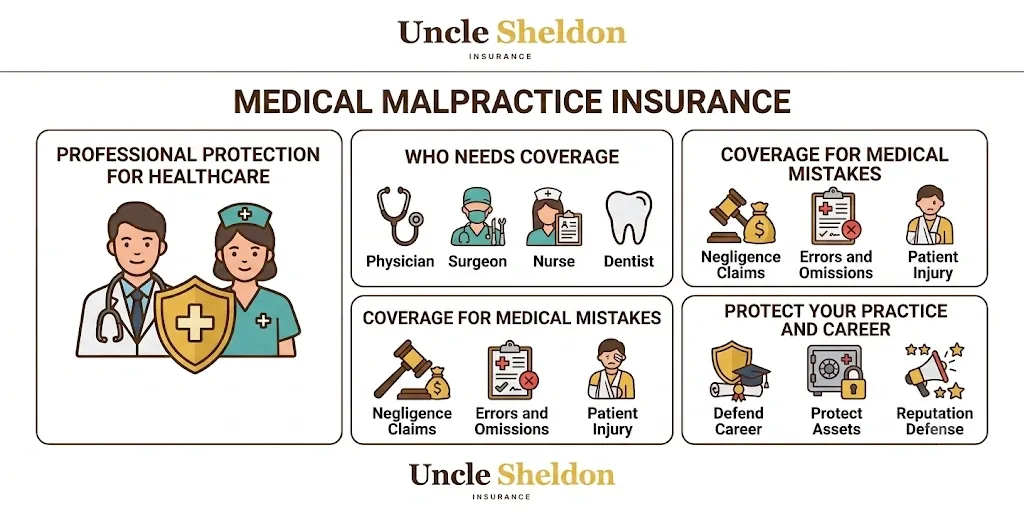
Who Needs This Coverage
Medical malpractice insurance isn’t just for surgeons and hospital systems. The list of healthcare providers who need it is broader than most people assume.
Physicians and surgeons — this is the most obvious category, but it covers a wide range of specialties from primary care to high-risk procedural specialties.
Nurses and nurse practitioners — NPs and advanced practice nurses operating with prescriptive authority and independent patient relationships carry real liability exposure and need their own coverage, even when employed.
Dentists and oral surgeons — dental malpractice claims are their own category of coverage and are typically issued through carriers that specialize in dental professional liability.
Mental health providers — psychiatrists, psychologists, licensed clinical social workers, therapists, and counselors all have patient relationships that can generate claims.
Chiropractors and physical therapists — manual therapy and rehabilitative care create their own liability profile.
Pharmacists — dispensing errors, drug interactions, and counseling failures are all potential sources of claims.
Medical assistants and technicians — depending on scope of practice, allied health workers may need their own coverage or may need to verify what’s covered under an employer’s policy.
Telehealth providers — this is a newer and genuinely complex category. Providing care across state lines through a telehealth platform creates multi-state licensing and coverage questions that a standard policy may not address without specific attention.
The general rule is this: if you have a patient relationship and your clinical judgment or actions can be the basis of a negligence claim, you need malpractice coverage. The exact form that coverage takes varies by specialty and practice setting.
Occurrence vs. Claims-Made — The One You Actually Need to Understand
This is the most important structural concept in medical malpractice insurance, and a lot of providers don’t understand it until they have a gap in coverage. It’s worth slowing down here.
Occurrence policies cover incidents that happen during the policy period, regardless of when the claim is filed. If the policy was active when the care was provided, you’re covered — even if the patient doesn’t file a lawsuit until five years later. Occurrence coverage is simpler and doesn’t create the coverage gap problem described below.
Claims-made policies cover claims that are both filed and reported while the policy is active. If your policy lapses, is cancelled, or you change carriers and leave a claims-made policy without appropriate arrangements, you can have a period where past care is effectively uncovered. The incident happened when you were insured, but the claim arrives after the policy ended.
In medical malpractice, claims-made is far more common than occurrence. Most carriers that write medical professional liability use the claims-made form. That’s not inherently a problem, but it means two pieces of coverage become critical.
Tail coverage (formally called an extended reporting period endorsement) extends the window for reporting claims after a claims-made policy ends. When you retire, change carriers, or leave a practice, you need tail coverage to protect yourself for the claims that haven’t been filed yet but are based on care you provided during the policy period. Tail coverage typically costs somewhere between one and three times your annual premium as a one-time purchase. It’s not cheap, but the alternative is an unprotected gap in your coverage history.
Prior acts coverage (sometimes called nose coverage) works from the other direction. When you move to a new claims-made policy with a new carrier, prior acts coverage extends that new policy backward to cover incidents from previous policy periods. It accomplishes the same goal as tail coverage but is added at the front of the new policy rather than the back of the old one.
| Coverage Type | What It Does | When You Need It |
|---|---|---|
| Occurrence policy | Covers incidents during policy period, claims can be filed anytime after | When you can find it — simplest long-term protection |
| Claims-made policy | Covers claims filed while policy is active | Most common form; requires attention to gaps |
| Tail coverage | Extends reporting window after claims-made policy ends | Retiring, changing carriers, leaving a practice |
| Prior acts / nose coverage | New policy covers incidents from prior periods | Starting a new claims-made policy after a gap |
What the Policy Actually Covers
A standard medical malpractice policy covers professional liability — claims arising from the provision of, or failure to provide, professional medical services. In plain terms:
Legal defense costs — The policy pays for your attorney and all associated costs of defending a claim. In many policies, defense costs are covered in addition to the policy limits (sometimes called “outside the limits” defense). In others, defense costs are paid from within the same limits (called “eroding limits” or “defense within limits”). This distinction matters more than it might seem — if you have a $1 million limit and the defense of a lengthy case consumes $400,000 of it, you have less cushion for any resulting settlement or judgment.
Settlements — If a claim is resolved through a negotiated settlement, the policy pays the agreed-upon amount up to the policy limits.
Judgments — If a case goes to trial and results in a verdict against you, the policy covers the judgment up to your limits.
Disciplinary proceedings — Some policies include defense costs for licensing board investigations or disciplinary hearings. Not all do. If this matters to you, it’s worth verifying specifically.
HIPAA proceedings — Some professional liability policies include limited coverage for regulatory proceedings related to HIPAA violations. Again, not universal.
The Consent to Settle Clause
This deserves its own mention because it affects your control over the outcome of a claim.
Some malpractice policies include what’s called a “consent to settle” or “hammer clause.” Under this provision, you have the right to refuse a settlement your insurer wants to pursue. However, if you refuse a settlement and the case goes to trial with a worse outcome, your liability for the amount above the refused settlement offer can shift to you. Some policies soften this — they allow you to refuse settlement without penalty. Others are stricter.
For many providers, especially physicians, the decision to settle a claim isn’t just financial. A settlement can affect your National Practitioner Data Bank (NPDB) report, which follows you and is visible to hospitals and credentialing bodies. Having input into the settlement decision matters. Understanding your policy’s consent clause before you need to use it matters.
What It Doesn’t Cover
Knowing the exclusions helps you avoid assumptions that could leave you exposed.
Intentional or criminal acts — If a patient claim involves allegations of intentional harm, sexual misconduct, or criminal behavior, standard malpractice policies exclude coverage. Some carriers offer separate sexual misconduct coverage as an endorsement; it’s worth asking about if that’s a relevant concern for your practice.
Business and employment disputes — Disputes with employees, partners, or business associates aren’t professional liability claims. Those situations call for employment practices liability or general business liability coverage.
Premises liability — If a patient slips and falls in your waiting room, that’s a general liability claim, not a malpractice claim. Most healthcare providers need both professional liability and general liability coverage, often bundled together.
Claims outside your scope of practice — If you provided care outside your licensed scope and a claim arises from that, coverage may be contested. This is rare in practice but worth noting.
Prior known incidents — If you’re already aware of a situation that’s likely to generate a claim when you apply for a new policy, that specific matter will typically be excluded from coverage under the new policy.
How Premiums Are Set
Medical malpractice premiums vary enormously depending on specialty, location, claims history, and coverage limits. It’s one of the more complex lines of insurance to price, and the differences by specialty are dramatic.
Specialty is the biggest driver. High-risk procedural specialties — obstetrics, neurosurgery, orthopedic surgery, cardiovascular surgery — carry the highest premium exposure. The claims in these specialties tend to be more severe and more expensive to defend and resolve. Primary care physicians, internists, and lower-risk specialties pay substantially less.
State matters a great deal. States with high jury verdicts, few damage caps, and active plaintiff bars are more expensive markets for malpractice insurance. Some states have statutory caps on non-economic damages (pain and suffering) which tend to moderate the cost of coverage. States without caps or with weak caps tend to have higher premiums.
Claims history follows you. Prior paid claims, settlements, or extended litigation in your history affects your options and your premium. Carriers can and do decline applicants with significant claims histories, especially in higher-risk specialties.
Coverage limits — The most common limits for individual physicians are $1 million per occurrence and $3 million aggregate, though some practice settings and contractual requirements push for higher limits. Hospitals and practice groups may require employed physicians to carry $1M/$3M as a condition of employment.
Practice setting and volume — Solo practitioners, group practice members, employed physicians, and locum tenens providers all have different exposure profiles. Volume of patients and procedures affects pricing.
Here’s a rough order-of-magnitude sense of the range, though actual quotes vary significantly:
| Specialty Category | Approximate Annual Premium Range |
|---|---|
| Low-risk specialties (psychiatry, pathology, internal medicine) | $3,000 – $15,000 |
| Mid-risk specialties (family medicine, pediatrics, anesthesia) | $10,000 – $30,000 |
| High-risk specialties (general surgery, orthopedics, ER medicine) | $25,000 – $75,000 |
| Very high-risk specialties (OB/GYN, neurosurgery, cardiac surgery) | $50,000 – $200,000+ |
These are rough ranges. Actual pricing depends heavily on state and specific claim history.
Employed Providers and the Coverage Gap
A lot of healthcare providers assume that because their employer carries malpractice insurance, they’re fully covered. That’s often true — but not always, and the gaps matter.
If you’re employed by a hospital system, medical group, or health system, you’re likely covered under their policy for care you provide in the course of employment. But that coverage doesn’t automatically extend to:
- Moonlighting shifts at other facilities
- Locum tenens work you pick up independently
- Volunteer clinical work
- Care you provide after you leave that employer (prior acts coverage when you move on)
- Telehealth work on platforms not affiliated with your employer
It’s worth getting a clear, written answer from your employer about what exactly their policy covers and where the edges are. And if you have any clinical activity outside of your primary employment, you may need your own supplemental coverage.
Locum Tenens and Short-Term Assignments
Locum tenens work has its own coverage complexities that deserve specific mention. When you work through a locum tenens agency, the agency typically provides coverage — but not all agency policies are equal, and the specifics of what’s covered (and the limits) vary.
Questions worth asking before any locum assignment:
- Is the coverage claims-made or occurrence?
- If claims-made, does the agency provide tail coverage when the assignment ends?
- What are the per-occurrence and aggregate limits?
- Does the coverage follow me if a claim arises from this assignment after I’ve moved on?
Some locum providers purchase their own portable malpractice coverage to ensure continuity regardless of which agency’s policy applies. Whether that’s worth it depends on your volume of locum work and how often you’re moving between agencies.
When You’re Getting Credentialed
Hospital and facility privileges almost universally require proof of malpractice coverage, and they often specify minimum limits. The credentialing process will ask for your certificate of insurance and, in many cases, will verify directly with your carrier.
Make sure your coverage limits meet the minimums required by any facility where you have or seek privileges. $1M/$3M is the most common minimum, but some academic medical centers or larger hospital systems require higher limits. If you’re in the process of credentialing at a new facility, check their requirements before your policy renews so you can adjust limits if needed.
Risk Management and Its Effect on Your Coverage
Carriers that specialize in medical professional liability often offer meaningful premium discounts to providers who complete risk management training. These are programs — often online, sometimes in-person — that cover topics like documentation practices, informed consent, patient communication, and managing difficult clinical situations.
Beyond the discount, risk management training actually matters for claims prevention. The most common factors in malpractice claims are documentation gaps, poor patient communication, failure to follow up on test results, and informed consent deficiencies. Good habits in these areas don’t eliminate claims, but they reduce their frequency and often improve the defensibility of cases that do arise.
Some carriers also offer resources like 24-hour risk management hotlines where you can call after a difficult patient encounter or adverse outcome for guidance on how to handle it — before it becomes a formal claim. That kind of proactive support is worth asking about when you’re evaluating carriers.
Choosing the Right Carrier
Not all medical malpractice carriers are the same. There are national carriers, regional carriers, specialty-specific mutual companies, and risk retention groups. Some things worth paying attention to when evaluating your options:
Financial strength — A carrier’s AM Best rating tells you about their financial stability. A rating of A or better is generally what you want for a coverage line this significant.
Claims handling reputation — How a carrier handles claims matters as much as the policy itself. Carriers that have a reputation for aggressive defense, strong support for physicians, and fair claims handling are worth seeking out. This is harder to find publicly, but talking to colleagues and consulting with an independent broker who places a lot of professional liability business can surface this.
Defense counsel — Some policies give you the right to select your own defense attorney. Others assign counsel. If the ability to choose your own attorney matters to you, look for policies with “consent to counsel” language.
Specialty focus — Carriers that specialize in a particular specialty often have deeper expertise in defending those specific claims, better relationships with expert witnesses, and more relevant risk management resources.
Don’t Figure This Out Alone
Medical malpractice insurance is not the kind of coverage you want to figure out alone using a comparison website. The claims-made versus occurrence question alone can create real coverage gaps if you don’t get it right, and the tail coverage conversation at the end of a policy is something a lot of providers genuinely aren’t prepared for until it’s in front of them.
We work with healthcare providers of all types to find professional liability coverage that actually fits their practice. We’re independent, which means we’re not captive to one carrier — we can shop your coverage and compare options across multiple companies to find the right combination of coverage, limits, and pricing for your specific situation.
We’re also real people. If you’re a new physician coming out of residency trying to figure out how your first policy should be structured, or an established provider who’s leaving a group practice and suddenly needs to understand tail coverage for the first time, we’ll explain it clearly and honestly. Not in insurance jargon. Just in plain language that helps you make a good decision.
Reach out if you want to talk through your situation. We’re happy to start with a conversation.