
Wildfire Insurance Agency Experts
Fire is probably the oldest risk that insurance was ever designed to protect against. The first formal fire insurance policies go back to England after the Great Fire of London in 1666, when it became pretty obvious that people needed a way to recover financially from catastrophic loss. Hundreds of years later the concept hasn’t changed much — you pay a premium, and if fire destroys what you own, the insurer helps you rebuild.
What has changed is how complicated the coverage landscape has gotten. In most of the country, fire protection is bundled into a homeowners or commercial property policy and people don’t think about it separately. But in parts of the country where wildfire risk has escalated dramatically — particularly in California, Colorado, Oregon, and other western states — the fire coverage question has become a whole separate and often stressful conversation. Insurers are pulling out of high-risk markets, homeowners are getting non-renewed after decades with the same carrier, and people are scrambling to figure out what their options even are.
Whether you’re in a low-risk area and just want to understand what your current policy actually covers, or you’re in a high-risk zone and trying to figure out how to get covered at all, the fundamentals of fire insurance are worth understanding clearly.
How Fire Coverage Usually Works
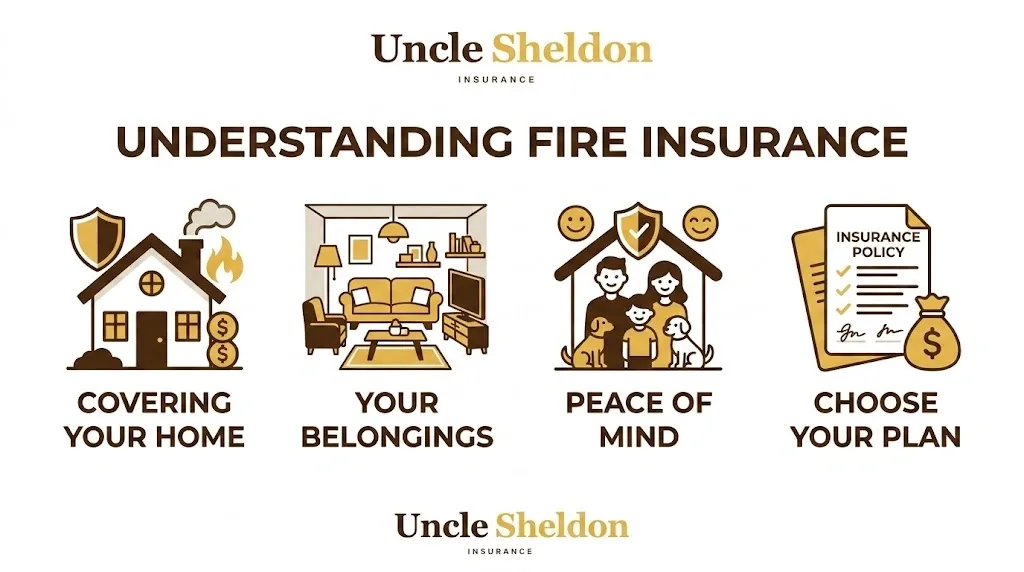
In most cases, fire coverage isn’t something you buy as a separate standalone policy — it’s a covered peril inside your homeowners insurance, renters insurance, or commercial property policy. Fire is one of the most fundamental risks that property insurance was built around, and almost every standard property policy covers it.
For homeowners, a standard policy (typically an HO-3 or similar) covers damage from fire and smoke under the dwelling coverage section. That coverage pays to repair or rebuild the physical structure of your home. It’s not the only part of the policy that matters in a fire loss though — you also have:
Personal property coverage — Your furniture, clothing, electronics, appliances, and other belongings are covered up to your personal property limit. In a significant fire, personal property losses can be substantial and the limit matters.
Other structures coverage — Detached garages, fences, sheds, and other structures on your property are typically covered at a percentage of your dwelling limit, often ten percent. If you have a large detached garage or a workshop on your property, ten percent of your dwelling coverage might not be enough to replace it.
Additional living expenses (ALE) or loss of use — This is the coverage that pays for you to live somewhere else while your home is being repaired or rebuilt after a fire. Hotel bills, restaurant meals above what you normally spend, the cost of a rental home — ALE covers the difference between your normal living costs and what you’re actually paying while displaced. A major rebuild can take many months or longer, and ALE coverage with inadequate limits or a time cap can leave families stretched thin toward the end of a long rebuild.
For renters, fire coverage works differently because you don’t own the structure. Your renters insurance covers your personal belongings inside the unit if they’re damaged or destroyed by fire, and it covers your additional living expenses if you’re displaced. The building itself is the landlord’s problem — they need their own property coverage for that.
For businesses, fire coverage falls under commercial property insurance. It covers the building (if you own it), your business personal property, equipment, inventory, and depending on the policy, business income loss during the period you can’t operate.
The Part Most People Get Wrong — Coverage Limits
Having fire insurance and having enough fire insurance are two different things, and the gap between them catches a lot of people off guard.
The single biggest issue in property insurance — especially after major fire events — is underinsurance. Policies that looked perfectly fine when they were written are suddenly inadequate because construction costs have risen, or because the home has been improved over the years, or because the original limit was simply set too low.
Insurance companies cover the cost to rebuild, not the market value of your home. Those two numbers can be very different. You might own a home with a market value of $400,000 in a desirable area, but if the structure costs $600,000 to rebuild from scratch (materials, labor, permits, demolition of what’s left), a $400,000 dwelling limit leaves you $200,000 short.
Replacement cost is what it costs to rebuild with materials of like kind and quality. Actual cash value is replacement cost minus depreciation. These are fundamentally different coverage types and the difference matters enormously when you have a total loss.
| Coverage Type | What Gets Paid | Real World Impact |
|---|---|---|
| Replacement cost | Cost to rebuild/replace with comparable materials | Covers the actual cost of rebuilding |
| Actual cash value | Replacement cost minus depreciation | Older home or older belongings = significant deduction |
| Extended replacement cost | Dwelling limit + an additional percentage buffer (often 25–50%) | Provides cushion when rebuild costs exceed the policy limit |
| Guaranteed replacement cost | Pays the actual rebuild cost regardless of the policy limit | Strongest coverage; not available from all carriers |
Extended and guaranteed replacement cost options exist specifically because people have been underinsured after fires. If your carrier offers either of these options, they’re worth considering seriously.
Beyond the dwelling itself, personal property limits deserve attention. After a fire, most people are surprised by how much their belongings actually cost to replace. Go room by room and think about what it would realistically cost to replace everything — the furniture, the appliances, the clothes in every closet, the kitchen equipment, the tools in the garage, the electronics. Most people significantly underestimate this number.
Ordinance or Law Coverage — The One People Don’t Know They Need
Here’s one of the most overlooked gaps in fire insurance. If your home is significantly damaged and needs to be rebuilt, the rebuild has to meet current building codes — which may be substantially different from the codes in place when your home was originally constructed.
An older home might need updated electrical, plumbing to current standards, additional insulation, changes to structural components, or other upgrades required by current code that the original structure didn’t have. Your standard dwelling coverage pays to rebuild what was there, at current prices, but it doesn’t always cover the additional cost of required code upgrades.
Ordinance or law coverage fills this gap. It covers the cost of bringing the rebuilt structure up to current code requirements. For older homes especially, this can be a meaningful number. It’s typically available as an endorsement and shouldn’t be skipped.
Smoke Damage Is Fire Damage
This seems obvious but it trips people up sometimes. Standard fire insurance covers smoke damage, not just flames. Smoke can travel far from the source of a fire and cause significant damage to belongings and structures that the flames never touched directly.
In wildfire situations, homes in the path of smoke from a fire miles away can suffer interior smoke contamination serious enough to require professional remediation. Smoke damage claims in wildfire events are real and can be substantial.
If your home experiences smoke infiltration from a nearby fire, document it carefully and talk to your insurer. It’s a covered peril under a standard policy.
Wildfires and the Changing Insurance Landscape
This is where fire insurance gets complicated in a way that didn’t exist for most homeowners a generation ago.
In high-risk wildfire zones — primarily in western states — the insurance market has changed dramatically in recent years. Carriers have experienced significant losses from catastrophic wildfire events and have responded by non-renewing policies in high-risk areas, tightening underwriting standards, or pulling out of certain markets entirely.
For homeowners in these areas, this has created a real problem. People who have owned their homes for decades and maintained continuous coverage are getting non-renewal notices, often with limited notice, and discovering that finding a replacement policy isn’t straightforward.
The FAIR Plan — Most states with significant wildfire exposure have a FAIR Plan (Fair Access to Insurance Requirements) — a state-backed insurer of last resort that provides basic fire coverage to people who can’t get coverage in the standard market. California’s FAIR Plan is the most widely known, but many other states have similar programs.
FAIR Plans provide coverage, but they’re not a full replacement for a standard homeowners policy. They typically cover the dwelling for fire and a limited set of perils, but they don’t include liability coverage, personal property at the same levels, or the other coverages built into a standard HO policy. Homeowners often need to purchase a “difference in conditions” (DIC) policy alongside FAIR Plan coverage to fill in the gaps.
FAIR Plans also tend to be more expensive than standard market coverage and have their own coverage limits and underwriting requirements.
Surplus lines insurers — For homeowners who don’t qualify for standard market coverage but need something beyond a FAIR Plan, surplus lines carriers are another option. These are insurers that operate outside the standard admitted market, often covering risks that standard carriers won’t touch. Coverage through surplus lines can be more comprehensive than a FAIR Plan but is typically more expensive.
Wildfire mitigation — In high-risk areas, what you do to harden your home against wildfire can affect whether you can get covered and at what price. Defensible space (clearing vegetation around the structure), ember-resistant vents, fire-resistant roofing materials, enclosed eaves — these mitigation measures are increasingly valued by insurers and can sometimes help maintain or obtain coverage. Some states have programs that certify homes as meeting wildfire mitigation standards, which can help with insurability.
If you’re in a high-risk area and dealing with the insurance market challenges, talking to an independent agent who works with multiple carriers — including surplus lines options — is genuinely useful. There’s no single right answer for everyone, and the options vary significantly by location and property characteristics.
How Fire Risk Gets Evaluated
Insurance carriers look at a number of factors when underwriting a property for fire coverage. Understanding what they look at helps explain why rates and availability vary so much.
Protection class — This is a rating system (generally 1 through 10) that reflects the quality of fire protection services available to a property. A class 1 means excellent fire protection — close fire station, hydrant nearby, well-equipped department. A class 10 means effectively no public fire protection. Properties in rural areas with volunteer fire departments and no nearby hydrants often end up in higher protection classes, which affects both availability and pricing.
Construction type — Wood frame construction burns differently than masonry or fire-resistive construction. A wood-frame home carries more fire risk than a masonry structure. The roofing material matters too — wood shingles are a fire risk; tile, metal, and Class A asphalt shingles are significantly better.
Age of the home — Older homes may have older electrical systems that present fire risk. Knob and tube wiring, aluminum wiring in certain configurations, outdated panels — these are things insurers look at. Updating them can affect both insurability and premium.
Proximity to wildfire risk — In wildfire-prone areas, carriers use increasingly sophisticated tools to assess wildfire risk for specific parcels. The same town can have properties with very different risk profiles depending on topography, vegetation type, and proximity to wildland.
Claims history — Prior fire claims on a property follow it. Multiple claims can affect availability and price.
Heating sources — Wood stoves and pellet stoves require disclosure and sometimes specific underwriting. Space heaters and other non-permanent heating sources are a factor. Chimneys need to be maintained, and insurers sometimes ask about that.
Electrical and mechanical systems — For commercial properties especially, the condition of electrical systems, fire suppression systems, and other mechanical features affects the underwriting.
After a Fire — What the Claims Process Looks Like
This is something most people don’t think about until they’re living it, and knowing what to expect helps.
When you have a fire loss, the first calls you make should be to the fire department (if you haven’t already), and then to your insurer to report the claim. Your insurer will assign an adjuster to your claim. The adjuster’s job is to evaluate the damage, determine what’s covered, and calculate the payout.
A few things worth knowing going in:
Document everything. Before anything is touched or moved, photograph and video the damage thoroughly. This becomes your record of what was there and what was destroyed. In a significant fire loss, documentation of personal property is critical and often difficult after the fact.
Get your own estimate. You’re not required to accept the first number the insurer’s adjuster puts forward. You have the right to get your own contractor estimates. For significant losses, a public adjuster — an independent adjuster who represents you rather than the insurance company — can sometimes help you recover more than you would navigating the process alone, particularly if there are disputes about the scope of damage.
Understand the timeline. Rebuilding after a significant fire takes time. Permits, contractor availability, material lead times — a major rebuild can take a year or longer. Make sure your additional living expense coverage is adequate for that timeline, and track every expense carefully because you’ll need documentation.
Keep records of everything. Every receipt, every invoice, every communication with the insurer — keep it all. Claims disputes are easier to resolve with a complete paper trail.
Know about the matching issue. If fire damages part of your home — say, one side of the exterior — and the replacement materials don’t perfectly match the undamaged portion (because that siding or roofing material has been discontinued), some policies have language about matching. It’s worth understanding what your policy says about this before you need it.
For Business Owners
Fire protection for a business operates under the same basic principles but with additional layers of complexity.
Commercial property insurance covers your building (if you own it), your business personal property, and your equipment and inventory. But a fire that takes your business offline doesn’t just cost you the value of what was destroyed — it costs you the income you can’t generate while you’re closed.
Business interruption insurance (also called business income insurance) covers the revenue your business loses during the period when a covered fire forces you to suspend operations. It’s typically written as part of a commercial property policy or a business owner’s policy (BOP), and it’s a coverage that a lot of business owners don’t think about separately until they’re dealing with an extended closure.
If your building burns and repairs take six months, the business interruption coverage is what keeps you from going under financially while the physical repairs happen. Payroll, rent, loan payments — these continue even when revenue doesn’t.
Extra expense coverage, which often pairs with business interruption, covers the additional costs of continuing operations in some form during the repair period — renting temporary space, expediting repairs, working from a different location.
For business owners, the fire insurance question is really a combination of these coverages working together, and making sure all of them are adequately sized for the scale of the operation matters.
Specific Types of Properties With Specific Needs
Not all properties fit neatly into a standard homeowners or commercial property policy, and fire coverage for them needs specific attention.
Older homes — Homes with older construction, historical significance, or unusual characteristics may need specialty coverage or may require specific underwriting attention to get adequate fire coverage.
Vacant properties — A home or commercial property sitting vacant is a significantly higher fire risk than an occupied one. Standard policies often have vacancy clauses that limit or exclude coverage after a certain period of vacancy (often sixty days). Vacant property coverage is a separate product.
Under construction — A property being built or significantly renovated needs builders risk insurance, not a standard homeowners or commercial property policy. Fire during construction is a real risk, and a standard policy usually doesn’t apply until construction is complete.
Mobile and manufactured homes — These have their own form of property insurance with specific underwriting. Fire coverage is included but the policy form and available coverages differ from a standard HO policy.
Farms and agricultural properties — Farm policies have their own structure, and fire coverage for farm buildings, equipment, crops, and livestock requires specific attention.
A Real Agent for Your Fire Coverage
Fire insurance isn’t one-size-fits-all, and the difference between a policy that fully covers you and one that leaves gaps can be significant. Replacement cost versus actual cash value, ordinance or law coverage, adequate ALE limits, the right dwelling limit to actually rebuild — these details matter, and they’re the kind of thing that’s worth having a real person review with you rather than just clicking through an online form.
We’re an independent agency, which means we work with multiple carriers. We’re not stuck recommending one company’s product. When we look at your situation — your property, your location, your risk profile, what you’re trying to protect — we can compare real options and find coverage that actually fits.
If you’re in a wildfire-prone area and dealing with the complexity of finding coverage after a non-renewal, we can help navigate that too. We work with standard carriers, specialty markets, and surplus lines options, and we’ll be honest with you about what’s available and what isn’t.
And if you already have coverage but aren’t sure it’s adequate — if it’s been a few years since you looked at your dwelling limit or you’ve made significant improvements to your home — that conversation is worth having. Being underinsured only becomes a problem when you actually need to use the coverage.
Reach out and let’s take a look at what you have.