
Your Complete Guide to Navigating Trailer Insurance
Don’t know where to start with trailer insurance? We can completly relate. When most people buy a trailer—whether it’s a small utility trailer for weekend yard work, a massive fifth-wheel travel trailer for cross-country road trips, or a heavy-duty cargo hauler for their local landscaping business—the insurance aspect is usually an afterthought. You are excited about the purchase and just want to get it hooked up to the truck and get moving.
But here is the thing we see all the time at our agency: ignoring trailer insurance until you actually need it is a recipe for a massive financial headache.
Consult with yoru local Uncle Sheldon insurance agent to learn more about how Uncle Sheldon finds the best policies for trailer insurance. We are real humans who genuinely want to make sure you have the right coverage in place before you hit the road. We are going to break down exactly what you need to know about insuring your trailer, without all the confusing corporate jargon.
The Biggest Misconception: “My Truck Insurance Covers It, Right?”
This is hands down the most common question we get, and it’s also the most dangerous misconception out there. The short answer is: Probably not in the way you think.
There is a huge difference between liability coverage and physical damage coverage when you are towing something down the road.
When you hitch a trailer to your insured pickup truck or SUV, your auto policy’s liability coverage generally extends to the trailer. This means if you are driving down the highway, merge carelessly, and the trailer you are towing swings out and smashes into the side of another car, your auto policy will typically pay for the damage you caused to the other person’s vehicle, up to your policy limits.
However—and this is a massive “however”—your auto policy will almost never pay to repair or replace the trailer itself if it gets damaged.
If you back your expensive brand new travel trailer into a giant tree at a cramped campsite, your auto insurance is not going to cut you a check to fix the massive dent in the fiberglass. If a brutal hail storm rolls through and destroys the roof of your cargo trailer while it’s parked in your driveway, your truck’s insurance won’t help you at all. If someone breaks into the storage lot in the middle of the night and simply steals the trailer entirely, you are out of luck unless you have a dedicated trailer insurance policy.
To make it incredibly clear, here is a quick breakdown of how the coverage typically works:
| Scenario | Auto Policy Liability | Auto Policy Collision/Comp | Dedicated Trailer Policy |
|---|---|---|---|
| Your trailer hits another car | Covered | Not Covered | Not Covered (Auto handles this) |
| You back the trailer into a pole | Not Covered | Not Covered | Covered |
| A tree falls on the parked trailer | Not Covered | Not Covered | Covered |
| The trailer is stolen from a lot | Not Covered | Not Covered | Covered |
Relying solely on the vehicle towing it is a massive gamble that leaves the physical value of your trailer completly unprotected.
What Types of Trailers Actually Need Insurance?
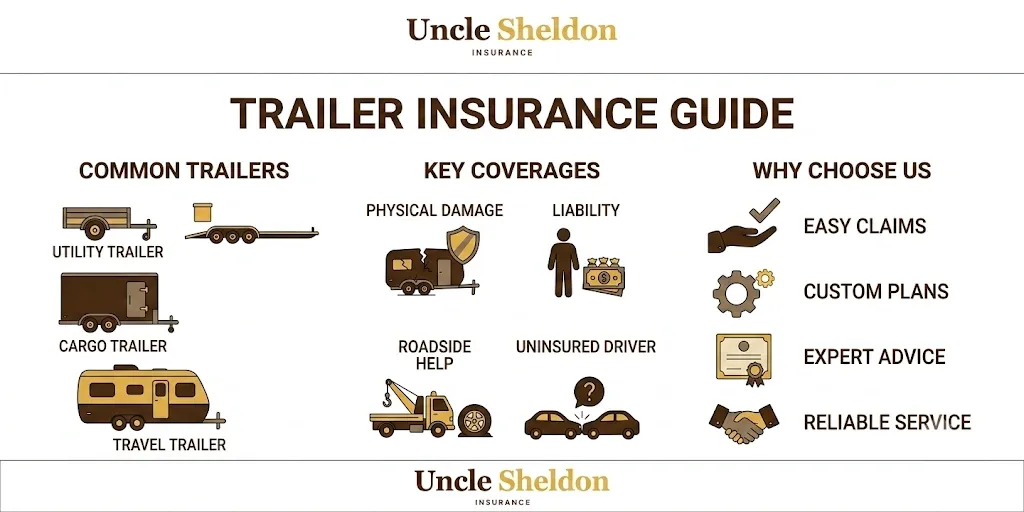
The term “trailer” is incredibly broad. It covers everything from a $500 flatbed you bought off Craigslist to haul lawnmowers, to a $100,000 luxury fifth-wheel that is essentially a rolling mansion. The type of trailer you have dictates the kind of policy you need.
Here are the main categories we deal with every single day:
Travel Trailers and Campers
This includes pop-up campers, teardrop trailers, standard bumper-pull travel trailers, and massive fifth-wheels. Because these are essentially homes on wheels, they require specialized coverage that looks a lot like a hybrid between auto insurance and a homeowners policy. They have plumbing, electrical systems, expensive appliances, and lots of personal belongings inside that need protecting.
Utility and Flatbed Trailers
These are the workhorses. Open flatbeds, enclosed landscaping trailers, dump trailers, and small utility trailers used for hauling ATVs, motorcycles, or just taking junk to the dump. While they are less complicated than a travel trailer, they are still valuable assets that are highly susceptible to theft and road damage.
Cargo and Enclosed Trailers
Often used by contractors, musicians hauling gear, or businesses moving inventory. The trailer itself needs coverage, but you also have to think heavily about the valuable contents inside. A standard trailer policy won’t automatically cover $20,000 worth of power tools sitting inside the cargo trailer—that requires a specific inland marine or commercial endorsement.
Horse and Livestock Trailers
These are highly specialized. Not only do you have to worry about the physical structure of a very expensive trailer, but you are hauling precious, living cargo.
Boat Trailers
Usually, your actual boat insurance policy can be structured to include coverage for the trailer it sits on. However, if it isn’t, you need to make sure the trailer is explicitly listed on a policy so you aren’t left stranded at the boat ramp with a broken axle and no coverage.
What Does a Dedicated Trailer Policy Cover?
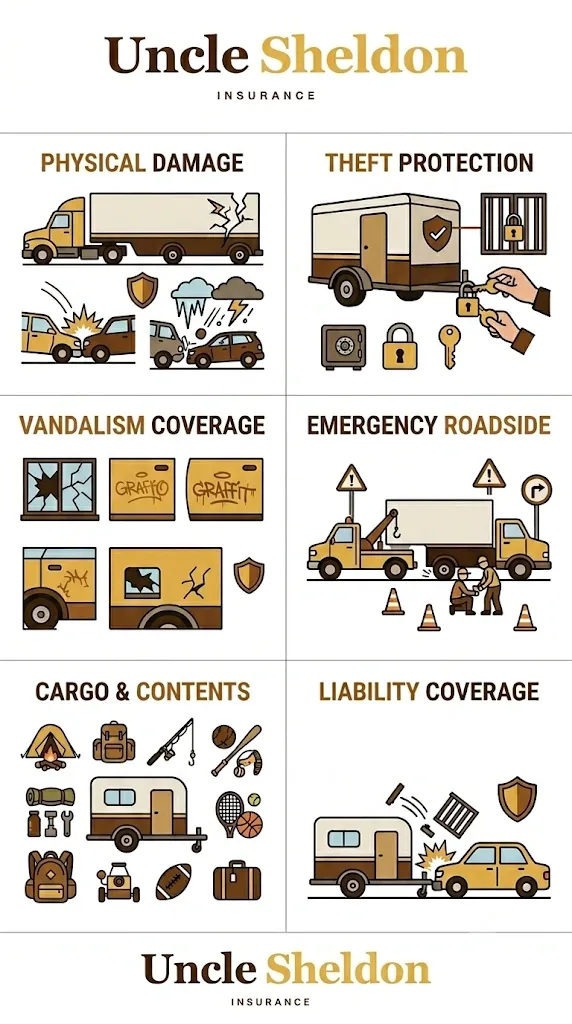
When you work with an Uncle Sheldon agent to build a policy, we want to make sure you understand exactly what you are paying for. A good, comprehensive trailer insurance policy is usually broken down into a few core components.
Comprehensive Coverage (Acts of Nature and Theft)
This is vital for any trailer that spends time parked outside, which is almost all of them. Comprehensive covers damage that happens when you are not driving. This includes massive hail storms that dent the aluminum siding, a heavy tree branch falling on the roof during a windstorm, vandalism at a public storage facility, fire, and total theft. Trailers are unfortunately incredibly easy to steal, making comprehensive coverage an absolute must-have.
Collision Coverage
This covers the physical damage to your trailer if you hit something, or if something hits you. If you misjudge a tight corner and scrape the side of your travel trailer against a brick wall, collision coverage pays for the repairs. It also covers you if you are involved in a wreck on the highway and the trailer rolls over or is crushed.
Total Loss Replacement
If you buy a brand new, expensive travel trailer, you should strongly consider a total loss replacement endorsement. If your brand new trailer is totaled in a terrible accident within the first few years of owning it, standard policies will only pay you the depreciated “actual cash value” of the trailer. A total loss replacement policy will actually step up and buy you a brand new trailer of the same make and model, saving you from taking a massive depreciation hit.
Contents and Personal Effects
If you have a travel trailer, think about everything you pack inside it: laptops, expensive camping gear, bicycles, clothes, pots and pans, and televisions. Standard trailer insurance covers the structure, but you need a specific personal effects endorsement to cover the stuff inside it if it gets stolen or burns up in a fire.
Emergency Expense and Towing
Breaking down on the side of the highway is stressful enough. Breaking down when you are dragging 10,000 pounds of metal behind you is a total nightmare. Emergency expense coverage helps pay for specialized heavy-duty towing to get the trailer to a repair shop. If you are on a vacation in your travel trailer, it can also help cover the cost of a hotel room and food while the trailer is stuck in the shop getting fixed.
Commercial vs. Personal Trailer Insurance
This is a critical distinction that trips up a lot of honest folks.
If you are using your trailer for any sort of business purpose, you absolutely must have a commercial policy.
Let’s say you own a heavy-duty dump trailer. If you just use it to haul mulch for your own personal garden on the weekends, a personal policy is fine. But, if you use that exact same trailer to haul debris away for your roofing business, or if you rent it out to neighbors for cash on the weekends, it is now a commercial vehicle.
If you try to file a claim on a personal policy for an accident that happened while you were doing commercial work, the insurance company will investigate, discover the business use, and immediately deny the claim. Don’t risk your livelihood to save a few bucks on a personal policy. Uncle Sheldon is your local fun independent agent who can help you find no hassle quotes on commercial auto and trailer insurance so you know you are properly protected on the job site.
How Much Does Trailer Insurance Actually Cost?
Because we are an independent agency, we have the ability to shop your specific situation around to multiple different carriers to find the best rate. We never want you overpaying.
The cost of trailer insurance varies wildly depending on exactly what you are hauling and how you use it. A small $1,000 open utility trailer might only cost $50 to $100 a year to fully insure. On the other hand, a luxurious $80,000 fifth-wheel travel trailer with all the bells and whistles could easily cost $500 to $1,000 a year to properly protect.
Here are the main factors the insurance underwriters look at when determining your premium rate:
- The Value of the Trailer: A more expensive trailer simply costs more to replace, so the premium is naturally higher.
- The Type of Trailer: Travel trailers and horse trailers are generally more expensive to insure than simple flatbeds because they are vastly more complex to repair.
- Where It is Stored: A trailer kept locked inside a secure, alarmed garage in a quiet neighborhood will cost less to insure than a trailer parked out on the street or in an unsecured, open dirt lot.
- Your Driving Record: Because you have to tow it, your personal driving history plays a big role. If you have a history of speeding tickets and at-fault accidents, carriers will view you as a higher risk to be towing a heavy load.
- Deductible Choice: Choosing a higher deductible (the amount you pay out of pocket before the insurance kicks in) will lower your annual premium cost.
Things to Consider When Choosing a Policy
When you sit down with an Uncle Sheldon agent, we don’t just hand you a generic piece of paper and ask for a check. We want to actually talk about how you use the equipment. Here are a few questions we might ask to make sure we are finding the right fit:
Do you live in the trailer full-time? If you have sold your house and are traveling the country full-time in your RV or travel trailer, standard recreational insurance is not enough. You need a specialized “Full-Timer” policy that acts much more like a traditional homeowners policy, providing comprehensive personal liability coverage for when you are parked at an RV resort for months at a time.
Are you renting the trailer out to others? Platforms like Outdoorsy and RVshare are incredibly popular right now. It’s a great way to make extra cash when you aren’t using your camper. However, standard policies almost universally exclude coverage if you rent the trailer out for money. You have to make sure you have a commercial endorsement or that the rental platform provides adequate primary coverage during the rental period.
What is actually sitting inside the trailer? We mentioned this before, but it’s worth repeating. If you are a contractor hauling $15,000 worth of specialized tools in an enclosed cargo trailer, the trailer policy only covers the metal box. We need to look at an Inland Marine policy or a robust commercial property endorsement to protect the expensive gear inside.
Why Work With Uncle Sheldon for Your Trailer?
Let’s be real, dealing with insurance isn’t exactly a fun Saturday activity. It can be confusing, frustrating, and incredibly tedious if you try to do it all yourself by clicking around random websites.
We utilize technology to make the process easier, not replace the human aspect of the business. Work with a real human agent, not a robot. Work with a family member you can trust.
Uncle Sheldon was started with the simple idea to help our community with insurance, whether it be for personal or commercial needs. We are an independent agency and work with multiple carriers helping you to find the right fit for your needs. We don’t work for one massive insurance conglomerate; we work for you. We can take the details of your brand new travel trailer or your trusty old utility flatbed and shop it across several highly-rated carriers to find the perfect balance of robust coverage and a price that makes sense for your budget.
We treat others like family and with honesty and care. Our team is transparent with all of our clients. If your current auto policy truly provides enough coverage for your tiny little yard trailer and you don’t need a standalone policy, we will be honest and tell you that. We aren’t here to aggressively sell you things you don’t need.
But if you do need coverage, you want to know that you are protected when a blowout on the highway causes you to swipe a guardrail, or a thief decides they want your cargo trailer more than you do.
Don’t know where to start with trailer insurance? We can help! Consult with yoru local Uncle Sheldon insurance agent to learn more about how Uncle Sheldon finds the best policies for trailer insurance. Give us a call or drop by the office. Let’s get your trailer properly insured so you can stop worrying about the “what-ifs” and just focus on enjoying the trip, getting the job done, and safely getting where you need to go. If we can’t help you find the coverage you need, we will try to help you find someone who might be able to. We want you to succeed.