
Your Auto Policy Probably Won’t Cut It
This is the thing most RV owners find out too late. You buy a rig, you’re excited, you want to hit the road, and somewhere along the way someone tells you to just add it to your auto policy. And that might technically work — sort of — for a small travel trailer on a short trip. But for anything beyond the most basic situation, your auto policy leaves a lot of gaps that can really hurt you when something goes wrong.
RVs are fundamentally different from regular vehicles. They’re also homes. They carry your stuff — your furniture, your electronics, your clothes, your kitchen equipment. When you’re parked at a campsite, you’re living in that thing. And when something goes wrong, whether it’s a crash on the highway, a windstorm at the campground, or someone breaking in while you’re out hiking — you need coverage that understands what an RV actually is.
That’s what RV-specific insurance is built for.
The RV World Is More Varied Than People Realize
Before getting into coverage, it helps to understand the different types of RVs because the insurance options and requirements vary depending on what you have.
Class A Motorhomes — The big ones. These are the full-size bus-style motorhomes, usually 26 to 45 feet long. High value, high replacement cost, and they need serious coverage to match.
Class B Motorhomes — Also called camper vans. Built on a van chassis, much more compact. Great for solo travelers or couples who want something nimble.
Class C Motorhomes — Mid-size motorhomes built on a truck or van chassis with that distinctive cab-over section over the cab. Popular family option.
Travel Trailers — Towed behind a vehicle. One of the most common RV types. Range from small basic units to large luxury trailers with slide-outs and full kitchens.
Fifth Wheel Trailers — A larger type of tow-behind trailer that connects to a hitch mounted in the bed of a pickup truck. Often used by full-timers because of the extra living space.
Toy Haulers — Travel trailers or fifth wheels with a garage area in the back for hauling motorcycles, ATVs, or other gear.
Pop-Up Campers and Folding Trailers — Lightweight, collapsible camping trailers. Lower cost and simpler coverage needs compared to larger rigs.
The distinction between motorized RVs (Class A, B, C) and towable RVs (travel trailers, fifth wheels) matters for insurance purposes. Motorhomes need their own liability coverage because they’re self-propelled vehicles. Towables may get some liability coverage extended from your tow vehicle’s policy, but that doesn’t mean the rest of the coverage picture is handled.
What RV Insurance Actually Covers
A proper RV policy puts several different types of coverage together in one place.
Collision Coverage
Pays for damage to your RV when it’s involved in a collision with another vehicle or object. If you clip a guardrail trying to navigate a narrow campground road, or get rear-ended at a stoplight, collision is what handles the repair or replacement of your rig.
Comprehensive Coverage
Covers damage that isn’t from a collision — think storms, hail, fire, theft, flooding, falling trees, animal strikes. If a hailstorm tears up the roof of your motorhome while it’s parked at a campsite, comprehensive is what you’re filing on.
Liability Coverage
If you’re at fault for an accident and cause injury or property damage to someone else, liability coverage pays for their damages and your legal defense. For motorhomes this is essential — you’re operating a very large vehicle, and the potential for serious damage in an accident is significant. For towable RVs, your tow vehicle’s liability coverage often extends to the trailer while it’s being towed, but once you’re parked and living in it, that extension typically doesn’t apply.
Medical Payments
Covers medical expenses for you and your passengers after an accident, regardless of fault. The limits on this are usually lower, but it handles immediate medical costs without having to wait for liability to sort out.
Uninsured and Underinsured Motorist
If you’re hit by a driver who has no insurance or not enough insurance to cover your damages, this coverage steps in. Given how expensive RV repairs can be, having this in place is smart.
The Coverage That Makes RV Insurance Different
Beyond the standard auto-type coverages, a good RV policy has options that are specific to the RV lifestyle. These are what really separate proper RV insurance from just slapping a vehicle policy on your rig.
Vacation Liability
This is one of the most important and most overlooked coverages. When your RV is parked and you’re using it as a residence — at a campsite, an RV park, or anywhere else — you have premises liability exposure just like you would in a home. If a guest slips on your steps, if a kid gets hurt near your rig, if you accidentally cause damage at the campsite, vacation liability is what responds to those claims. Your auto liability coverage generally does not cover this.
Personal Belongings Coverage
Your homeowner’s or renter’s policy might extend some coverage to your belongings when they’re temporarily away from home, but the limits can be low and the coverage may not be well-suited to RV life. A dedicated RV policy can include coverage specifically for the stuff you keep in your rig — cookware, clothes, electronics, bikes, camping gear. For full-timers especially, this is critical because the RV is where everything they own lives.
Full-Timer Coverage
This is the big one for people who live in their RV full-time or for a significant part of the year. If your RV is your primary residence, you need coverage that treats it that way. Full-timer coverage essentially bridges the gap between auto insurance and home insurance, providing liability protection, personal belongings coverage, and loss of use coverage that makes sense for someone whose home is on wheels.
Most standard RV policies are written assuming occasional recreational use. If you’re a full-timer and you’re not telling your insurance company that, you could find yourself in a very uncomfortable conversation after a claim.
Emergency Expense Coverage
If your RV breaks down or is damaged far from home and you can’t use it, this coverage helps pay for temporary housing and additional transportation while your rig is being repaired. Being stranded 800 miles from home in a disabled motorhome is a situation nobody plans for, but it happens, and having some coverage to cover a hotel and a rental car is genuinely useful.
Total Loss Replacement
This is an endorsement worth understanding. If your RV is totaled, a standard policy pays you the actual cash value — which accounts for depreciation. For a rig that’s a few years old, that number can be significantly less than what you paid for it and what it would cost to replace it with something comparable. Total loss replacement coverage instead pays you enough to buy a comparable new model, not the depreciated value of what you lost. For newer rigs especially, this is worth having a serious conversation about.
Roadside Assistance
Breaking down in a regular car is inconvenient. Breaking down in a 40-foot motorhome in the middle of nowhere is a completely different problem. Standard roadside assistance programs often aren’t equipped to handle large motorhomes. RV-specific roadside assistance covers things like tire changes on large rigs, fuel delivery, battery service, and lockout help — and can coordinate with services that can actually handle the size of vehicle you have.
Roof Coverage
Worth asking about specifically. RV roofs take a beating — from branches, hail, the elements — and some policies handle roof damage differently than the rest of the structure. Know what you have here before you assume the roof is covered the same as everything else.
Full-Timer vs. Part-Timer — Why It Really Matters
This distinction is more important than most RV owners realize, and it’s worth taking a moment on.
If you use your RV recreationally — a few weekends a year, a summer trip, that kind of thing — a standard recreational RV policy is built for you. The assumption is that most of the time, the rig is parked at home or in storage, and you’re out in it occasionally.
Full-timers are in a completely different situation. If you live in your RV for six months or more per year, or if the RV is your primary residence, you’re essentially living without home insurance if you only have a standard recreational policy. The liability exposure alone is significant — you don’t have homeowner’s liability, you don’t have standard tenant liability, and your auto liability doesn’t cover you when you’re parked and living in the rig.
Full-timer policies are more like a combination of auto insurance and home insurance. They cost more than standard recreational policies, but for someone who is genuinely living in their RV, the coverage is much more appropriate.
| Situation | What You Need |
|---|---|
| Occasional weekend or vacation use | Standard recreational RV policy |
| Extended trips, several weeks per year | Standard policy, possibly with enhanced personal property limits |
| Living in RV for 6+ months per year | Full-timer coverage with vacation liability and enhanced personal belongings |
| Full-time RV as primary residence | Full-timer policy; treat it like home insurance for a mobile home |
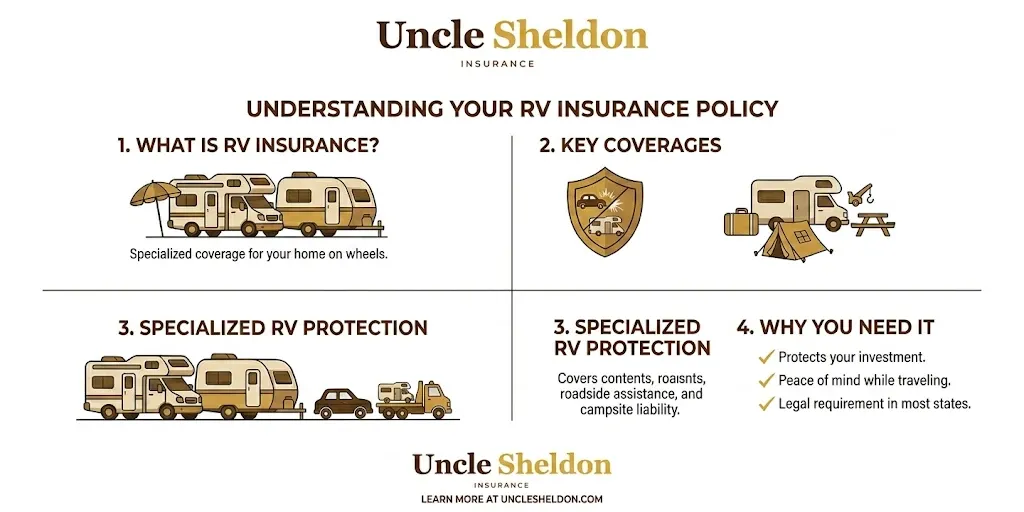
Be honest with your agent about how you use the rig. It affects what kind of policy you need, and misrepresenting your usage can cause real problems at claim time.
What Affects the Cost of RV Insurance
A lot of factors go into the premium for an RV policy. Here’s what underwriters generally look at:
Type and class of RV — A Class A motorhome costs significantly more to insure than a basic travel trailer. Size, value, and whether it’s motorized all factor in.
Age and value of the rig — Newer, more expensive RVs cost more to insure. A well-maintained older rig that’s been paid off might have lower values driving the premium.
How often you use it — Occasional recreational users pay less than full-timers. More time on the road means more exposure.
Where you store it — Keeping the RV in a secured storage facility when not in use can help with theft and vandalism risk. Storing it outdoors in an area with severe weather exposure is a different story.
Your driving record — Just like auto insurance, your driving history matters. Prior accidents or traffic violations can push your rate up.
Coverage limits and deductibles — Higher limits cost more. Higher deductibles lower your premium but mean more out of pocket when you file a claim.
Claims history — Prior RV claims or a history of claims on other vehicles will affect your rate.
Full-timer status — Full-timer policies carry a higher premium than recreational policies because of the broader coverage and greater exposure.
State Requirements
Unlike regular auto insurance, there’s no single nationwide standard for RV insurance requirements. A few things to know:
For motorized RVs, most states require at minimum the same liability coverage they require for any other motor vehicle. You generally can’t legally drive a Class A motorhome on public roads without meeting your state’s minimum liability requirements. The minimums vary by state, and many people choose limits well above the minimum because of the potential severity of accidents involving large vehicles.
For towable RVs like travel trailers and fifth wheels, most states don’t require separate liability insurance on the trailer itself, because the liability coverage on the tow vehicle typically extends to the trailer while it’s being towed. However, this doesn’t mean you should skip RV-specific coverage — it just means the liability requirement is usually handled through the tow vehicle’s policy while in motion.
Storage and campground requirements vary. Some private campgrounds and RV parks require guests to show proof of insurance. Full-timers using campgrounds as their home base often run into this.
If you spend time in Canada or Mexico, make sure you understand how your RV policy handles coverage across borders. Not all policies automatically extend to other countries.
Storage and Seasonal Coverage
For people who only use their RV seasonally, there’s an option worth knowing about — storage or lay-up coverage. During the months your RV is in storage and not being driven, you may be able to reduce your liability and collision coverage while keeping comprehensive coverage active. Comprehensive still matters in storage because fire, theft, hail, tree damage, and other non-collision events don’t take the winter off.
This can meaningfully reduce your annual premium if you’re a seasonal user. Ask your agent whether this option makes sense for your situation.
Getting the Right Policy
One thing that’s genuinely worth saying here is that not every insurance company handles RV coverage the same way. There are companies that specialize in RV insurance with policies built specifically around the RV lifestyle — full-timer options, vacation liability, roadside assistance programs designed for large rigs, total loss replacement — and there are companies that just tack it onto a standard auto framework and call it done.
The difference shows up most clearly when you actually need to use the coverage. A carrier that understands RVs will have adjusters and claims processes that know how to handle the specific situations that come up. A carrier that doesn’t will be figuring it out alongside you, and that’s not a great position to be in when you’re dealing with a significant claim.
As an independent agency, we work with multiple carriers, and we can put your situation in front of companies that actually specialize in this space. We’re not locked into one option.
Coverage That Fits How You Actually Use Your RV
Whether you’ve got a brand new Class A motorhome, a vintage Airstream, or a basic travel trailer you take out a few times a summer, we can help you find coverage that actually fits how you use the thing.
We’ll ask the right questions — how often you use it, whether you full-time, how you store it, what state minimums you need to meet, and what the rig is worth — and we’ll find you options that make sense. We’re not going to just throw the cheapest number at you. We want you to understand what you’re buying.
Reach out and let’s figure out what you actually need. Real agent, real conversation.