
Renting in Colorado Is Awesome. The Risks Are Real Too.
Colorado draws people from all over the country. The mountains, the outdoor culture, the quality of life — it’s a genuinely great place to live. Whether you’re in a Denver high-rise, a Fort Collins apartment near campus, or a ski-in ski-out condo in Breckenridge, you’re a renter. And renters in Colorado have some specific things to think about when it comes to protecting their stuff and themselves.
Renter insurance is one of those coverages that a lot of people skip because it feels unnecessary until something actually goes wrong. A wildfire moves through a neighborhood. A hailstorm cracks windows and soaks your furniture. Your car gets broken into and your laptop and ski pass are gone. Your neighbor’s bathroom floods and the water comes through your ceiling. These aren’t rare situations in Colorado — they happen every year to real people who didn’t think it could happen to them.
The good news is that renter insurance in Colorado is genuinely affordable. Most people pay somewhere between $12 and $25 a month depending on where they live and what they’re covering. That’s not a lot of money for what you get. What you get is actual financial protection when life goes sideways.
At Uncle Sheldon, we’re not an algorithm. We’re a real insurance agency with real agents who can sit down with you (or hop on a call) and figure out what coverage actually makes sense for your situation. That’s kind of our whole thing.
What Renter Insurance Actually Covers
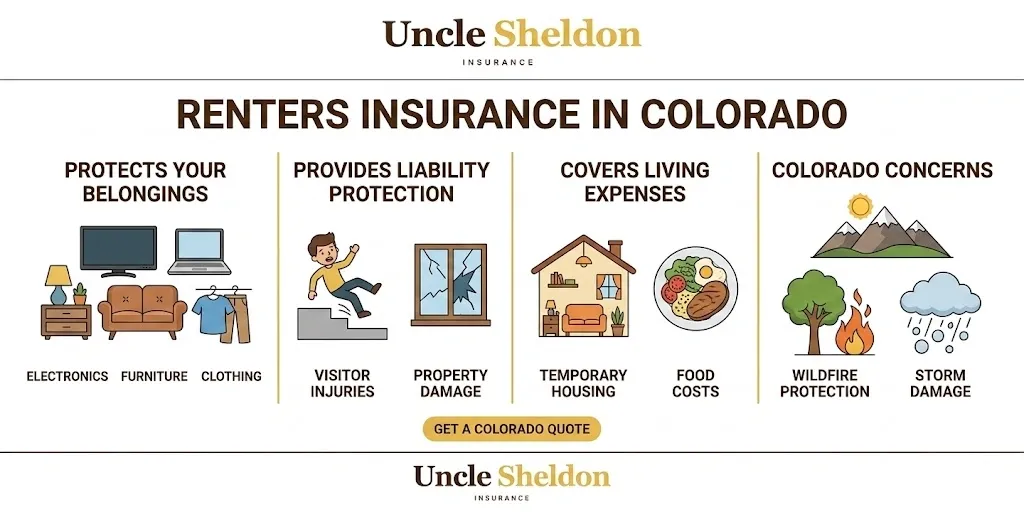
Before we get into the city-by-city breakdown, it helps to understand what a standard renter insurance policy covers. There are three main buckets.
Personal Property is the big one for most people. This covers your stuff — furniture, electronics, clothing, kitchen gear, bikes, ski equipment — if it’s damaged or stolen. Most policies cover fire, smoke, theft, vandalism, windstorm, and certain water damage. What it doesn’t cover by default is flooding from outside (like a river flooding your neighborhood) or earthquake damage. Both can be added in Colorado if you need them.
Personal Liability is the piece people forget about. If someone slips and falls in your apartment and decides to sue you, your renter’s insurance covers your legal costs and any settlement up to your policy limits. It also covers damage you accidentally cause to other people’s property — like if you forget the bathtub is running and flood the unit below you.
Additional Living Expenses covers where you stay if your rental becomes unlivable due to a covered event. If your building catches fire and you’re displaced, this pays for your hotel and extra food costs while you’re out.
| Coverage Type | What It Covers | Typical Limit |
|---|---|---|
| Personal Property | Furniture, electronics, clothing, gear, valuables | $15,000 to $50,000+ |
| Personal Liability | Injuries, lawsuits, property damage you cause | $100,000 to $300,000 |
| Additional Living Expenses | Hotel, food, costs if your unit is unlivable | 20–30% of personal property limit |
| Medical Payments | Minor injuries to guests regardless of fault | $1,000 to $5,000 |
One thing worth knowing in Colorado specifically — if you have expensive ski or outdoor gear, standard personal property limits might not cut it. Policies have sub-limits on things like jewelry, firearms, and sometimes electronics. If you’ve got $5,000 in ski equipment, it’s worth asking your agent whether you need a scheduled personal property endorsement.
The Colorado Weather Factor
Colorado weather is its own whole category. The Front Range gets some of the most frequent and severe hailstorms in the country. Hail Alley — the stretch from northern Colorado down through eastern Colorado and into Nebraska — hits hard. Denver, Colorado Springs, and Aurora all deal with it every summer. A bad hailstorm can break windows, flood basements, and damage your personal property if water gets in.
Wildfires are increasingly a real concern, especially in areas near the foothills and mountain communities. The Marshall Fire in Boulder County in December 2021 was a wake-up call — it was winter, the ground was dry, and neighborhoods burned fast. That fire displaced thousands of renters. The ones with renter insurance had a path to recovery. The ones without it were largely on their own.
Mountain towns deal with snow loads, ice dams, and the occasional frozen pipe situation. Pueblo and the eastern plains get intense wind. These aren’t reasons to panic — they’re reasons to have coverage.
| Colorado Risk Factor | Most Affected Areas | Relevant Coverage |
|---|---|---|
| Hailstorms | Denver, Aurora, Colorado Springs, Pueblo | Personal property (windstorm/hail) |
| Wildfire | Boulder, Estes Park, foothills communities | Personal property, additional living expenses |
| Heavy snow / roof damage | Mountain towns, all of Front Range | Water damage, personal property |
| Theft / break-ins | Urban areas, ski towns with gear | Personal property |
| Flooding (rivers) | Areas near rivers, foothills | Flood endorsement (separate policy) |
Denver
Denver is the big one. Over 700,000 people live in the city, and a huge chunk of them are renters. The rental market is competitive — neighborhoods like Capitol Hill, LoHi, Baker, RiNo, and Five Points are packed with apartments of every style and price range. Downtown lofts, Victorian row homes converted to rentals, new builds with stainless appliances and rooftop decks. The variety is part of what makes Denver interesting.
Renters in Denver face a few consistent risks. Theft is higher in urban environments, especially vehicle break-ins (and yes, your renter’s insurance typically covers stuff stolen from your car if you have the right policy). The city also sits right in hail territory — summer storms can be intense. And with a lot of older apartment buildings, water damage situations from plumbing failures are not uncommon.
Average renter insurance rates in Denver tend to sit in the $15 to $22 per month range for a basic policy. If you’ve got a lot of electronics or sporting equipment, you might need to bump up your personal property coverage, but even then it’s usually under $30.
Colorado Springs
Colorado Springs is the second-largest city in Colorado and has one of the fastest-growing renter populations in the state. With Pikes Peak right there, the military presence at Fort Carson and Peterson Space Force Base, and a strong outdoor recreation scene, it attracts a wide range of people.
Wildfire is a serious concern in Colorado Springs. The city experienced the Waldo Canyon Fire in 2012 and the Black Forest Fire in 2013 — both were devastating to neighborhoods in and around the city. Renter insurance with solid additional living expenses coverage is worth thinking carefully about here, because if a fire displaces you, you need somewhere to go.
Theft rates in Colorado Springs are something to be aware of, and if you’re renting near the downtown area or the tourist-heavy Manitou Springs corridor, it’s worth having coverage that actually reflects the value of what you own.
Aurora
Aurora is Denver’s neighbor to the east and often gets overlooked. It’s actually one of the most diverse cities in Colorado, with a large renter population spread across older apartment complexes and newer developments. Areas like Southlands on the far east side feel almost suburban, while central Aurora neighborhoods are denser and more urban.
Hail is a real factor in Aurora — it sits right in the core of Hail Alley. Renters on upper floors or in older buildings with less weatherproofing might find themselves dealing with water intrusion after a bad storm. Personal property coverage is important here, especially if you work from home and have equipment you rely on.
Aurora also has some of the more affordable rental rates compared to Denver proper, which means renter insurance is often a very small percentage of monthly housing costs.
Boulder
Boulder landlords frequently require proof of renter insurance before you can sign a lease. It’s common enough that having a policy is almost a given if you’re renting in the city.
For a closer look at the Boulder rental market specifically, including the gear coverage question, what wildfire displacement means for renters near the foothills, and what Boulder landlords actually require, the Boulder renter insurance page goes deeper on those details.
Lakewood
Lakewood sits just west of Denver on the way to the mountains. It’s a popular choice for people who want Denver’s access to the metro area but slightly lower rental prices and proximity to the foothills. The city has grown a lot in the past decade, with neighborhoods like Belmar turning into walkable urban centers.
Wildfire risk is elevated as you get closer to the foothills in Lakewood. The Green Mountain area and neighborhoods that back up to Jefferson County open space are in areas where fire can move. Renters here should think seriously about their coverage limits.
Thornton
Thornton is a north Denver suburb with a large working-class renter population and a lot of apartment complexes. It’s more affordable than Denver and attracts people who commute into the city or work in the northern suburbs.
Renter insurance in Thornton tends to be straightforward — standard personal property and liability coverage, competitive rates. Hail is a factor in this part of the Front Range, so making sure your policy covers that is important.
Westminster
Westminster sits between Denver and Boulder along the US-36 corridor and has seen significant development over the years. The Promenade development area changed the city’s identity somewhat, and rental housing options range widely.
From a renter insurance standpoint, Westminster is fairly standard Front Range risk — hail, some theft, and the occasional water damage situation. Rates here tend to be reasonable.
Arvada
Arvada is another northwest Denver suburb with a mix of older neighborhoods and newer developments. The Olde Town Arvada area has become a popular destination in its own right. Renters in Arvada have good access to the mountains while staying in a suburban environment.
Same hail and wildfire risk considerations as other Front Range communities, though Arvada is generally a lower-crime area which can help keep insurance rates down.
Pueblo
Pueblo is Colorado’s fourth-largest city and often overlooked. It’s more affordable than Denver and Colorado Springs, has a strong industrial heritage, and a rental market that reflects its working-class roots.
Pueblo sits in an area that gets intense wind and weather. Hailstorms, high winds, and summer thunderstorms are all real. Renters here should make sure their personal property coverage is adequate — and if you’re storing tools, equipment, or valuable items in a garage or storage unit attached to your rental, ask your agent how that’s covered.
Grand Junction
Grand Junction is the largest city on the Western Slope. It’s geographically removed from the Front Range and has its own distinct character — more arid, more conservative, strong connection to agriculture and energy industries.
Wildfire risk on the Western Slope is significant. The region around Grand Junction has experienced fires that have threatened communities. Renter insurance here should account for that risk, and additional living expenses coverage is worth thinking about if your rental is near any open land or mesa country.
Aspen
Aspen is where Colorado gets expensive. Very expensive. Rental prices here are among the highest in the state — a one-bedroom apartment can run well over $3,000 a month, and workforce housing is extremely limited. Renters who work in Aspen’s hospitality, ski, or service industries often deal with tight housing situations and high costs.
If you’re renting in Aspen, your personal property coverage probably needs to be higher than you’d think. People who live and work in ski towns tend to have gear — ski equipment, snowboards, outdoor clothing — that adds up fast. A solid set of ski gear can easily be $2,000 to $5,000 in value. Standard renter insurance has sub-limits on certain items, so talk to your agent about scheduled personal property if needed.
Theft can also be an issue in ski towns — vacation communities attract opportunists, and crowded, high-turnover rental situations can mean unlocked doors and distracted neighbors.
Vail
Vail has many of the same dynamics as Aspen. High rents, a seasonal population, a lot of people living in shared housing or employee housing situations, and expensive gear everywhere.
One thing to think about in Vail specifically is the mountain weather risk. Snow loads on roofs, ice dams causing water to back up into units, and the potential for pipe freeze situations in older buildings are all real. Renter insurance with strong water damage coverage is worth having.
If you’re in employee housing operated by Vail Resorts or another employer, ask specifically whether your personal property is covered under any building insurance — it almost certainly isn’t, which is why your own renter’s policy matters.
Breckenridge
Breckenridge is one of Colorado’s most visited ski towns and also has a real year-round community of residents who rent. Like Aspen and Vail, the cost of living is high and the rental market is tight.
Wildfire risk exists even in mountain towns — Breckenridge sits in Summit County and while the immediate town area is less exposed than some foothills communities, the surrounding forest is there. Additional living expenses coverage is a smart add in case something forces you out of your rental.
The outdoor gear situation is the same story as Aspen and Vail. Skis, bikes, camping equipment, climbing gear — if you’re a serious outdoor person living in Breckenridge, you probably have five figures of gear sitting in your closet or storage unit. Make sure your policy actually covers it.
Estes Park
Estes Park sits at the entrance to Rocky Mountain National Park and has a split personality. During tourist season, it’s packed. In the off-season, it’s a small town of a few thousand year-round residents. Renters here tend to be service industry workers, outdoor guides, and people who genuinely love living in a mountain community.
Wildfire risk in Estes Park is real — the Cameron Peak Fire in 2020 burned over 200,000 acres nearby. The town itself is relatively protected but the risk is not zero, and many renters in the area are in properties surrounded by trees and dry vegetation.
Flooding is also a consideration near the Big Thompson River corridor — the 1976 Big Thompson Flood is part of local memory, and flooding can happen again. If your rental is in a lower area near water, ask about flood coverage, because a standard renter’s policy won’t cover that.
Steamboat Springs
Steamboat is a ski town with a slightly different feel than the Aspen/Vail/Breckenridge corridor — more agricultural roots, a bit more rugged, strong ranching tradition alongside the ski resort culture. It attracts people who want mountain living without quite the intensity of the glitzy resort towns.
Renters here face mountain weather risks — snow, ice, frozen pipes in winter — and wildfire risk in the drier months. Gear is a factor, as always in ski towns. Renter insurance is widely available at reasonable rates even in Steamboat.
Durango
Durango is a four-season outdoor recreation hub in the southwest corner of Colorado. The Fort Lewis College population contributes to a healthy rental market, and the outdoor recreation scene means renters tend to have bikes, kayaks, camping equipment, and more in their apartments.
The Four Corners region of Colorado has experienced significant wildfire activity over the years. Durango is surrounded by national forest and has seen fire get uncomfortably close. This is one of those markets where renter insurance with real personal property coverage isn’t just nice to have — it’s genuinely useful.
Glenwood Springs
Glenwood Springs sits along I-70 between Denver and Grand Junction and is known for Glenwood Canyon, the hot springs, and being a transit point for mountain recreation. It also has a real community of renters who work in the local economy or commute to Aspen (a 45-minute drive).
The 2020 Grizzly Creek Fire burned through Glenwood Canyon and closed I-70 for weeks. Living along this corridor means accepting some wildfire and rockslide risk. Renters here should make sure their additional living expenses coverage is adequate if a natural disaster displaces them.
Centennial
Centennial is a planned city in Arapahoe County, southeast of Denver. It’s one of the more affluent suburbs in the metro area and has a growing rental market driven by people who want easy access to the Tech Center and surrounding employment hubs.
Standard Front Range risks apply in Centennial — hail is a real concern, and the area has seen some significant storms. Renters here often have newer, more valuable electronics and household goods given the demographics, so making sure personal property limits are adequate is worth the conversation.
What Landlords in Colorado Typically Require
Landlords in Colorado’s major cities have increasingly started requiring renter’s insurance as a lease condition. Here’s what the typical requirement looks like and what it usually means for coverage amounts.
| City | Landlord Requirement Trend | Typical Required Liability Limit |
|---|---|---|
| Denver | Very common in larger complexes | $100,000 |
| Boulder | Very common, often mandatory | $100,000 to $300,000 |
| Colorado Springs | Becoming more common | $100,000 |
| Fort Collins | Common in professionally managed units | $100,000 |
| Aspen / Vail / Breckenridge | Common in workforce and managed housing | $100,000 |
| Durango / Steamboat | Less common but growing | $100,000 |
| Pueblo / Grand Junction | Less common | Varies |
Even if your landlord doesn’t require it, the cost of not having it is usually a bad deal. If you’re in a month-to-month situation where a landlord doesn’t track compliance closely, it’s still on you to deal with the aftermath of a loss.
How Much Does Renter Insurance Cost in Colorado
Rates vary by location, coverage amount, and what you’re insuring. But here’s a general sense of what to expect across Colorado’s rental markets.
| City / Area | Estimated Monthly Rate | Key Rate Factors |
|---|---|---|
| Denver | $15 to $22 | Urban theft risk, hail exposure |
| Boulder | $16 to $24 | Higher property values, wildfire risk |
| Colorado Springs | $14 to $20 | Wildfire risk, theft rates |
| Fort Collins | $12 to $18 | Lower crime, good overall risk profile |
| Aspen / Vail | $18 to $30+ | High property values, gear coverage |
| Breckenridge | $16 to $25 | Mountain risks, gear |
| Estes Park | $14 to $22 | Wildfire, flood proximity |
| Pueblo | $13 to $19 | Wind and hail exposure |
| Grand Junction | $13 to $20 | Wildfire, Western Slope risks |
| Durango | $14 to $21 | Wildfire risk, college town |
These are estimates and your actual rate will depend on your specific situation. What you own, how much coverage you want, your deductible, and whether you bundle with auto insurance all factor in.
Things That Make Colorado Renter Insurance a Little Different
A few things come up often when we talk to Colorado renters that don’t always come up in other states.
Ski and Outdoor Gear — Colorado renters own a lot of expensive gear. A quality ski setup can easily be $2,000 to $4,000. Mountain bikes in the $3,000 to $7,000 range are common in places like Boulder, Durango, and Steamboat. Standard personal property coverage has sub-limits on certain items, and standalone gear isn’t always fully covered without a specific endorsement. Ask your agent about this.
Wildfire Smoke Damage — Even if your apartment doesn’t burn, wildfire smoke can cause significant damage to belongings. Air purifiers, clothing, electronics, and soft furnishings can all be affected. Smoke damage from a nearby fire may be covered under your personal property protection — worth confirming with your agent.
Roommate Situations — In expensive rental markets like Boulder, Aspen, and Denver, shared housing is common. Individual policies are generally the safer route because a roommate’s renter’s insurance typically doesn’t extend to your property. If you share a lease and your roommate’s guest breaks something of yours, you’ll want your own policy.
Marijuana and Your Policy — Cannabis is legal in Colorado and plenty of renters grow small amounts at home under state law. Be aware that some insurance policies have clauses that can complicate claims if cannabis is involved — for instance, if you’re growing plants and there’s a water damage situation. It’s worth being upfront with your agent about your situation rather than having a claim denied over something unexpected.
Flood vs. Water Damage — This distinction matters. Renter’s insurance typically covers sudden water damage from within the building (burst pipe, appliance failure, overflow). It does not cover flooding from outside — rising water, storm surge, overflowing rivers. If you’re near the Big Thompson, the Poudre, the Arkansas River, or any other waterway in Colorado, flood coverage through a separate policy is worth considering.
Working With Uncle Sheldon on Colorado Renter Insurance
Uncle Sheldon is an independent agency. That means we work with multiple carriers and don’t have a single product we’re trying to push. When you work with us, we look at your actual situation — where you’re renting, what you own, what your landlord requires, and what risks you actually face — and we find coverage that fits.
Colorado renters are our kind of people. Outdoor-oriented, practical, busy. You don’t want to spend three hours on the phone with an 800 number explaining your situation to someone reading from a script. We get that.
Our agents know Colorado. They understand the difference between renting in a wildfire-adjacent mountain community and renting in a Denver high-rise. They’ll ask the right questions and help you figure out coverage limits that actually make sense — not just the minimum that checks a box on a lease agreement.
If you’re in a ski town and worried about your gear, we can talk through that. If you’re in Boulder and your landlord is requiring a specific liability limit, we’ll match it. If you’re moving from out of state and just want someone to explain how it all works, that’s exactly what we’re here for.
You’re going to talk to a real person. Not a chatbot. Not an algorithm. Just a real agent who can answer your questions and help you make a decision you feel good about.
Reach out to Uncle Sheldon and let’s find you a policy that works for where you actually live.