
Box Trucks Are Their Own Category
A box truck — the kind with a cube-shaped cargo compartment fixed directly to the frame — is one of the most common vehicles in commercial use. Furniture delivery, appliance haulers, moving companies, local distributors, catering operations, food vendors, contractors hauling tools and materials. They are everywhere.
And yet box truck insurance is one of those areas where a lot of operators are underinsured or covered by the wrong type of policy without realizing it. The vehicle looks simple. It’s not a semi, it doesn’t have a trailer, there’s no CDL required for most sizes. So people often assume a regular commercial auto policy handles it. Sometimes it does. Sometimes it doesn’t, and the difference only becomes clear when a claim gets filed.
Box trucks typically range from about 10 feet to 26 feet in cargo length, and their Gross Vehicle Weight Rating (GVWR) typically falls between 10,000 and 33,000 pounds depending on the size. That GVWR number matters more than most operators realize — it determines what federal and state regulations apply to the vehicle, which in turn affects the insurance requirements.
The GVWR Line That Changes Everything
Most box trucks used for local and regional delivery fall below 26,001 pounds GVWR. Below that threshold, the vehicle generally does not require a commercial driver’s license to operate. But the federal standard for what counts as a “commercial motor vehicle” subject to FMCSA oversight is actually lower — 10,001 pounds GVWR or more, if the vehicle is used in interstate commerce.
So here’s the practical picture. A 16-foot box truck used to make deliveries that occasionally cross a state line is almost certainly subject to FMCSA requirements, even though the driver may not need a CDL, and even though the truck looks nothing like the semi-trucks most people associate with federal trucking regulations. If you are carrying freight for compensation and that truck weighs more than 10,000 pounds, federal rules likely apply to your operation.
This affects insurance because FMCSA-regulated carriers are required to maintain specific minimum liability coverage and, for interstate operators, file proof of that coverage electronically with the federal government. Missing those requirements doesn’t just create an insurance gap — it can mean operating without proper authority, which is a much bigger problem.
For box trucks operating purely within a single state and not carrying regulated freight for hire, state-level commercial auto requirements apply instead. Those vary by state, but they’re almost always higher than personal auto minimums.
Who Uses Box Trucks Commercially
The range of operators using box trucks is wide, and the insurance needs differ meaningfully across these use cases.
Moving and relocation companies — Both large national moving companies and small independent movers rely on box trucks. The cargo they carry — household goods — has specific insurance considerations, and the liability exposure during moves (property damage at customers’ homes, loading dock incidents) adds a layer beyond basic auto coverage.
Last-mile delivery — Amazon DSPs, grocery delivery services, furniture and appliance retailers doing their own delivery, and courier companies all use box trucks for that final leg of distribution. These operations often involve high daily mileage, multiple stops, and drivers who may be handling the cargo themselves.
Food service and catering — Refrigerated box trucks are common in catering, food distribution, and meal delivery operations. The refrigeration unit itself creates a separate coverage question that a standard auto policy won’t address.
Contractors and tradespeople — HVAC companies, plumbing supply, electrical contractors, and similar businesses often run box trucks loaded with equipment, parts, and materials. The tools and inventory inside the truck can represent significant value that needs its own coverage.
Retail and wholesale distributors — Businesses doing their own distribution to retail accounts, restaurants, or other commercial customers often maintain a small fleet of box trucks. The cargo being carried could be anything from food and beverage to hardware to medical supplies, and the appropriate cargo coverage changes accordingly.
Rental operations — Companies renting box trucks to individuals or businesses for short-term use carry commercial auto fleet policies with commercial rental coverage. The customer who rents the truck typically relies on the rental company’s policy as a base, sometimes supplemented by personal auto coverage or credit card benefits — though neither of those reliably covers a rented commercial vehicle.
Coverage Types That Apply to Box Trucks
Commercial Auto Liability
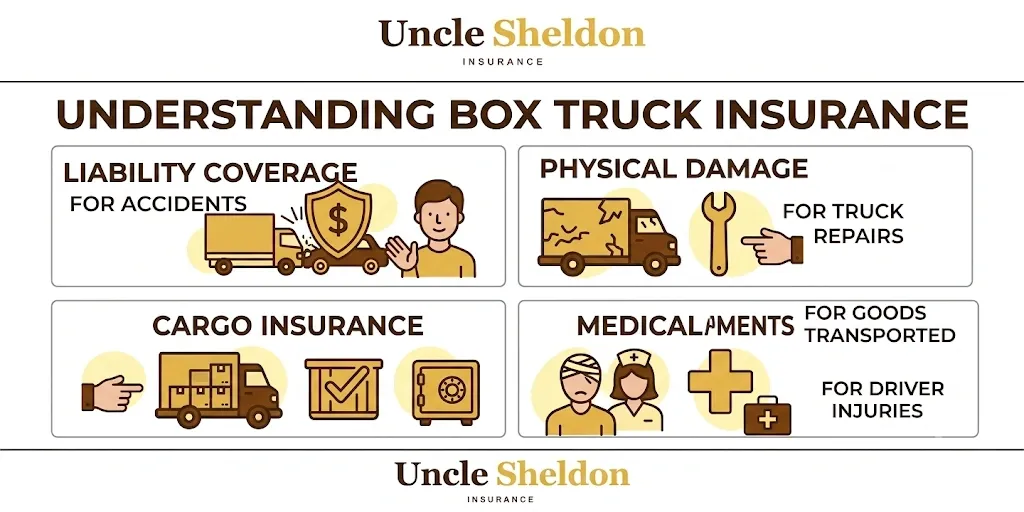
This is the foundation. Commercial auto liability covers bodily injury and property damage you cause to other people while operating the box truck. It pays the other party’s medical bills, vehicle repairs, and legal costs if you’re found at fault in an accident.
The minimum limits required vary by how the truck is used and where it operates. For FMCSA-regulated vehicles carrying non-hazardous freight in interstate commerce, the federal minimum is $750,000. Most shippers, customers, and freight brokers require at least $1 million in liability coverage, and for good reason — accidents involving large vehicles can result in serious injuries and very substantial damages.
State minimums for intrastate commercial vehicles vary widely but are almost always higher than personal auto minimums. Some states require $100,000 or more for commercial vehicles above certain weight thresholds.
Minimum limits should genuinely be thought of as a floor, not a target. A single bad accident with a loaded box truck can easily produce claims that exceed minimum limits, leaving the operator personally exposed for anything above the policy limit.
Physical Damage
Physical damage coverage protects the box truck itself — both the cab and the cargo box. This breaks into two parts: collision coverage for damage from accidents, and comprehensive coverage for everything else (theft, fire, hail, flooding, vandalism, falling objects).
If the truck is financed or leased, the lender almost certainly requires physical damage coverage. Even if it’s owned outright, leaving a $40,000 to $80,000 work vehicle uninsured for physical damage is a significant gamble. A truck that gets totaled in an accident or stolen overnight represents a major business disruption regardless of what the insurance claim would have covered.
One thing worth checking: some commercial auto policies insure the cab and chassis separately from the cargo box. If the body was added aftermarket, or if it’s a custom configuration (refrigerator unit, lift gate, specialized shelving), make sure the policy is covering the full replacement value of the vehicle as configured — not just the base chassis value.
Motor Truck Cargo
If you are hauling someone else’s freight for hire, cargo insurance is the coverage that protects that freight while it’s in your possession. As a carrier, you have a legal obligation to safeguard the goods you accept. Your customers will expect you to carry it, and most transportation contracts require it.
The appropriate cargo limit depends on the maximum value of any single shipment you would typically carry. If you’re hauling consumer electronics or medical equipment, that number can be very high. If you’re hauling building materials or dry goods, the per-load exposure is usually lower but still real.
Cargo policies come with their own exclusions. Certain commodities may be excluded from coverage or require specific endorsements. Refrigeration breakdown — a common issue for reefer box trucks — is typically not covered under a standard cargo form and needs its own endorsement. Theft of cargo is covered under most cargo policies, but the conditions vary, and some policies require specific security measures or exclude theft from unattended vehicles overnight.
General Liability
Commercial general liability for box truck operators covers bodily injury and property damage claims that arise from business activities but aren’t the result of operating the vehicle itself. Loading and unloading freight is the most common scenario — if a driver drops a piece of furniture while carrying it into a customer’s home, or damages a door frame during delivery, that’s a general liability claim, not an auto claim.
If you operate out of a warehouse, yard, or any physical location where customers or vendors come on-site, general liability also covers incidents at that location. Many shippers and contracts require proof of general liability coverage alongside auto coverage.
Non-Owned and Hired Auto
If your operation involves drivers using rented trucks, their personal vehicles, or vehicles they own that you don’t, non-owned and hired auto coverage extends your commercial auto liability to those vehicles. This matters for smaller operations that occasionally rent a bigger truck for a large job, or for businesses where employees sometimes drive their own vehicles for work purposes.
Without non-owned and hired auto coverage, a driver’s personal auto policy is the only coverage applying to that situation — and personal auto policies almost universally exclude commercial use for compensation.
Refrigerated Box Trucks — Extra Considerations
Reefer box trucks carry additional complexity. The refrigeration unit is typically one of the most expensive components of the vehicle and is subject to mechanical failure independent of any accident or external event. Standard commercial auto physical damage doesn’t cover mechanical breakdown.
Cargo spoilage is a related exposure. If the refrigeration unit fails during transit and the cargo is ruined, cargo insurance may or may not respond depending on the cause. A mechanical breakdown of the reefer unit causing spoilage is often excluded from standard cargo forms. Specific temperature-controlled cargo coverage or refrigeration breakdown coverage needs to be added explicitly if this is a real exposure in your operation.
What Affects Box Truck Insurance Premiums
Underwriters look at a range of factors when pricing a box truck policy. Some of the main ones:
| Factor | What It Affects |
|---|---|
| GVWR and vehicle size | Larger, heavier trucks cost more to cover and face stricter requirements |
| Driver history and age | MVR records and experience level are heavily weighted |
| Annual and daily mileage | More miles means more exposure |
| Cargo type | High-value or theft-prone freight increases cargo premiums |
| Operating radius | Interstate operations and overnight travel increase exposure |
| Prior claims history | At-fault accidents and cargo losses follow the operation |
| Safety equipment | Backup cameras, GPS tracking, and dash cams can help |
| Driver age | Very young or very new CDL holders typically pay more |
Driver history is usually the single biggest variable outside of the vehicle type itself. An operation with a clean driving record across its driver pool will pay materially less than one with at-fault accidents in the past three to five years. Carriers pull Motor Vehicle Records for all drivers, and any violations or accidents in that window show up.
Owner-Operators vs. Company Fleets
The insurance structure for an independent owner-operator running one or two box trucks differs from a company running a fleet of twenty.
For owner-operators, coverage is typically written on an individual commercial auto policy. Everything is tied to the specific truck or trucks listed, and the cost is sensitive to the owner-operator’s own driving record and claims history.
Fleet policies typically bundle multiple vehicles under one policy and can be structured to allow for a rotating pool of drivers rather than listing each driver individually. Fleet pricing also tends to reward loss history across the group — a fleet that has operated without major claims for several years may qualify for better rates than the same vehicles would if insured one at a time.
The right structure depends on the size of the operation and how drivers are assigned to vehicles. An independent agent can look at both options and explain the tradeoffs honestly.
Box Trucks in FMCSA-Regulated Operations
If your box truck operation requires FMCSA operating authority — because you’re hauling freight for hire across state lines and the truck weighs more than 10,000 pounds GVWR — the compliance side of your insurance program matters as much as the coverage itself.
FMCSA registration requires active insurance filings to maintain your authority. If your policy lapses or is cancelled, the insurer notifies the FMCSA electronically, and your operating authority can be suspended. Reinstating a lapsed authority takes time and during that period you legally cannot operate in interstate commerce for hire.
The filing itself (a BMC-91 or BMC-91X endorsement) needs to be placed by your insurance carrier or broker as part of the policy. It’s not a separate form you file yourself — it’s attached to the policy. When shopping for coverage, confirming that the carrier can make FMCSA filings correctly and on time is not a small detail.
When Personal Auto Isn’t Enough
A common scenario: a small business owner, an independent contractor, or a side-business operator uses a box truck occasionally for work. Maybe they rent one a few times a year for deliveries or hauls. They assume their personal auto insurance follows them to the rental.
Personal auto policies almost universally exclude commercial use. Using a vehicle to transport goods for compensation — even occasionally — typically voids the personal auto coverage for that trip. If an accident happens while the truck is being used for business purposes, the personal auto carrier can and often will deny the claim.
Commercial auto coverage is the correct product for any use of a vehicle to transport goods or provide services for compensation, regardless of how frequently that use occurs.
Renting Out Box Trucks
Businesses that rent box trucks to others operate under a commercial fleet policy that includes commercial rental endorsements. These policies are structured differently than operator policies because the vehicle is being driven by people who aren’t employees of the fleet owner.
Rental operators typically require renters to either show proof of their own commercial auto coverage, purchase a temporary liability endorsement from the rental company, or both. The liability exposure of a rental fleet is significant because the operator can’t control how renters drive.
If you’re renting a box truck for a job and don’t have commercial auto coverage of your own, the rental company’s liability coverage provides the minimum required protection, but it typically doesn’t cover damage to the rental truck itself. That cost falls on the renter unless a physical damage waiver is purchased. Those waivers can be expensive per day, which is worth factoring into the cost of the rental for any extended job.