
The Reality Of Refrigeration Failures
If you run a business that deals with perishable goods, you already know the low level anxiety of hoping the walk-in cooler stays cold. Whether you own a busy downtown restaurant, a local neighborhood grocery store, a high end flower shop, or a medical clinic storing expensive vaccines, your entire inventory relies on a constant, uninterrupted flow of electricity and functioning mechanical equipment.
And equipment fails. That is just what equipment does. Power grids go down. Compressors blow out in the middle of a sweltering summer weekend.
When that happens, the clock starts ticking immediately. You usually only have a few hours before the temperature creeps up and your entire inventory becomes completely worthless. Thousands, or even tens of thousands of dollars worth of prime steaks, fresh produce, delicate flowers, or critical medications can end up in the dumpster by Monday morning.
A lot of business owners assume their standard commercial property insurance will step in and cover the cost of all that ruined inventory. That assumption is almost always wrong. Standard property policies usually exclude damage caused by temperature changes or mechanical breakdowns.
To protect your perishable inventory from a sudden loss of refrigeration, you need a very specific, explicitly stated coverage called spoilage insurance. Let’s dig into exactly how this works, why you need it, and the pitfalls you need to avoid when setting up your policy.
How Spoilage Insurance Actually Works
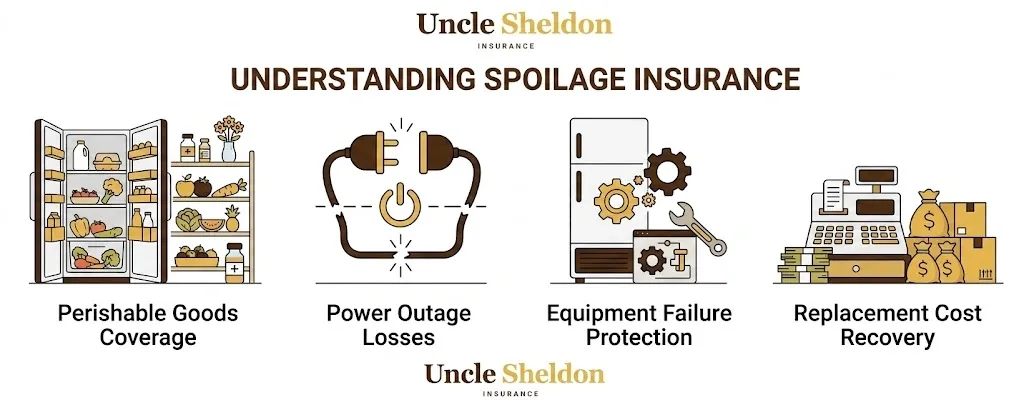
Spoilage insurance is designed to do one very specific job. It reimburses your business for the cost of perishable goods that are ruined due to a sudden and accidental change in temperature or humidity.
It is usually added as an endorsement to your main commercial property policy or your Business Owner’s Policy (BOP). It is not a standalone policy that you buy separately, but rather an extra layer of protection you bolt onto your existing coverage.
The coverage applies to inventory that is actively being stored in a refrigerated unit, a freezer, or a humidity controlled environment at your place of business. It is meant to cover the actual cost to replace the spoiled items. If you own a butcher shop and your freezer fails, spoiling $10,000 worth of premium beef, the spoilage endorsement pays you the $10,000 so you can buy new inventory from your suppliers and keep your business running.
But it is critical to understand the triggers. The insurance company isn’t just going to write a check anytime something goes bad. The spoilage has to be the direct result of a covered cause of loss, and those causes are usually broken down into two main categories: mechanical breakdown and power outages.
What Triggers A Spoilage Claim
For a spoilage claim to be approved, the failure usually has to fall into one of these specific buckets.
Mechanical Breakdown
This is when the equipment itself fails. The compressor motor burns out, a refrigerant line ruptures and leaks all the freon, or the internal thermostat malfunctions and causes the unit to overheat or freeze over. The failure must be sudden and accidental. It cannot be the result of a gradual wear and tear problem that you simply ignored for months. If the compressor fails because a belt snapped without warning, spoilage coverage kicks in.
Power Outages
This is the most common cause of spoilage. A severe thunderstorm knocks out the power lines, a drunk driver hits a utility pole down the street, or the local utility company simply experiences a localized blackout. If your business loses power, and that lack of power causes your coolers to warm up and spoil the inventory, the policy responds.
However, there are massive caveats when it comes to power outages, specifically regarding where the outage originated. We will discuss the difference between on-premises and off-premises outages shortly, because it is the number one reason spoilage claims get denied.
Equipment Breakdown vs Spoilage Coverage
This is probably the most confusing aspect of insuring refrigeration systems. Business owners often confuse Equipment Breakdown coverage with Spoilage coverage. You usually need both, but they do completely different things.
Let’s say the motor on your massive walk-in freezer completely seizes up and destroys the unit. It is going to cost $8,000 to repair the freezer itself, and while it was broken, $5,000 worth of seafood spoiled inside.
Equipment Breakdown Coverage pays the $8,000 to bring a repair technician out and physically fix the broken freezer motor. It covers the machinery.
Spoilage Coverage pays the $5,000 to replace the ruined seafood that was inside the freezer. It covers the perishable inventory.
If you only have Equipment Breakdown coverage, the insurance company will fix your freezer, but they won’t give you a dime for the ruined seafood. If you only have Spoilage coverage, they will pay for the ruined seafood, but you will have to pay the $8,000 out of pocket to fix the freezer.
To properly protect a business that relies on refrigeration, you absolutely must carry both endorsements on your commercial property policy. They work together hand in hand.
Determining How Much Coverage Your Business Needs
Figuring out the right limit for your spoilage coverage requires a bit of math and a realistic look at your operations. You don’t want to overpay for coverage you don’t need, but underinsuring yourself can be a fatal mistake for a small business.
The goal is to calculate the maximum potential value of all perishable goods you might have on hand at your absolute busiest time of the year.
If you own a florist shop, your inventory level in the middle of October might be relatively low. But the week before Valentine’s Day or Mother’s Day, every cooler you own is probably stuffed to the brim with expensive imported roses. Your spoilage limit needs to be high enough to cover that peak Valentine’s Day inventory. If your coolers fail on February 12th, you stand to lose massive amounts of money, and a low spoilage limit will leave you stranded.
You also need to think about the type of inventory you carry. A deli that mostly stores bulk cheeses and lunch meats will have a very different inventory value than a fine dining restaurant storing fresh truffles, live lobsters, and dry aged wagyu beef.
Sit down with your suppliers invoices and run the numbers. What would it actually cost to completely restock every cooler and freezer in your building tomorrow morning? That number should be your spoilage coverage limit.
The Financial Impact Of A Total Loss
A lot of business owners balk at adding extra endorsements to their policy because they are trying to keep their monthly overhead low. It is an understandable instinct. But when you are dealing with perishable inventory, the math heavily favors buying the coverage.
Spoilage insurance is generally very inexpensive. Depending on the limits you choose and the type of equipment you have, it might only cost a few hundred dollars a year to add a substantial amount of coverage to your BOP.
Compare that minor premium to the cost of a total loss. Let’s say you own a craft brewery, and you have $20,000 worth of specialized yeast and fresh hops stored in a temperature controlled room. A summer heatwave rolls through, the power grid fails for 24 hours, and the room hits 90 degrees. Everything is ruined.
If you don’t have spoilage coverage, that $20,000 loss comes directly out of your operating capital. Can your business absorb a sudden $20,000 cash flow hit and still make payroll on Friday? For many small businesses, a single massive inventory loss is enough to force them into bankruptcy. The small annual premium for spoilage insurance is the cost of protecting your cash flow and ensuring your business survives the week.
Dealing With Power Outages And Utilities
We need to circle back to power outages, because this is where the fine print of a spoilage policy becomes critical.
When a power outage causes your food to spoil, the insurance company will look closely at exactly where the power failed. Policies draw a strict line between an outage that happens on your property and an outage that happens away from your property.
On-Premises Power Failure
If the main circuit breaker inside your building blows out, or a tree falls in your parking lot and severs the specific power line running directly into your restaurant, that is an on-premises power failure. Standard spoilage coverage almost always covers this scenario because the failure happened directly at your insured location.
Off-Premises Power Failure
This is the dangerous one. An off-premises failure happens when the local utility company’s substation blows a transformer three miles down the road, plunging your entire side of town into darkness. The problem didn’t originate on your property; it originated with the utility provider.
Many basic spoilage endorsements specifically exclude off-premises power failures. If the blackout happens down the street, and your inventory ruins, they will deny the claim.
To protect against this, you must explicitly ask your insurance agent to include “Utility Services - Direct Damage” or ensure your spoilage endorsement specifically covers off-premises power interruption. If you operate in an area with an unreliable power grid or frequent summer storms, this off-premises extension is non-negotiable.
Common Industries That Cannot Skip This Coverage
While any business with a fridge could technically use spoilage coverage, there are several industries where operating without it is essentially playing Russian roulette with the company bank account.
Restaurants and Grocery Stores This is the most obvious category. If you serve food or sell food, your entire business model relies on refrigeration. A single prolonged power outage can wipe out your entire meat locker, dairy case, and produce section.
Florists and Nurseries Cut flowers are incredibly sensitive to temperature fluctuations. A cooler that gets a few degrees too warm can cause thousands of dollars of premium inventory to wilt and become completely unsellable overnight.
Medical Clinics and Pharmacies This is perhaps the most high stakes category. Many specialized medications, antibiotics, and vaccines must be kept within a strict temperature range. If a pharmacy cooler fails, the medication isn’t just ruined; it becomes dangerous to use. Furthermore, the financial value of a small cooler full of specialty pharmaceuticals can easily exceed $50,000 or $100,000.
Bakeries and Confectioners Expensive ingredients like specialized chocolates, dairy products, and certain doughs require strict climate control. A broken HVAC system in a chocolate shop during July can melt the entire front display case into a puddle.
The Role Of Temperature Alarms And Telematics
In the past, business owners simply locked the walk-in cooler at night and hoped for the best. Today, technology offers massive advantages in preventing spoilage losses before they happen.
Modern refrigeration units can be equipped with advanced telematics and temperature monitoring sensors. These systems monitor the internal temperature, humidity levels, and power supply 24/7. If the temperature fluctuates outside of a safe zone for more than a few minutes, the system immediately sends an automated text message or phone call to the business owner or a designated manager.
Insurance companies love these systems because they drastically reduce the severity of claims. If you get an alert at 2:00 AM that the freezer is warming up, you can drive to the restaurant, identify the blown fuse, and fix it before any inventory actually spoils. Because these systems are so effective at mitigating risk, many insurance carriers will offer a discount on your spoilage coverage premiums if you have monitored alarms installed and actively maintained.
Spoilage During Transit And Catering Operations
Standard spoilage endorsements are designed for inventory sitting stationary inside your building. But what happens if your business involves moving perishable goods?
If you run a catering company, a meal delivery service, or a high end bakery that delivers wedding cakes in a refrigerated van, your risk profile changes completely once the food leaves your premises. If the refrigeration unit on your delivery truck breaks down in the middle of a traffic jam in July, the standard spoilage endorsement on your property policy is not going to cover the loss of that inventory.
To protect goods in transit, you need a different type of coverage, usually referred to as Inland Marine insurance or a specific Motor Truck Cargo policy with a refrigeration breakdown endorsement. This covers the perishable goods while they are actively being transported. If your business model involves delivery, you must explicitly inform your agent so they can bridge the gap between your in-house coolers and your delivery vehicles.
Managing Supplier Relationships After A Loss
When a massive spoilage event happens, getting the insurance check is only half the battle. The other half is actually replacing the inventory fast enough to keep your customers happy and your doors open.
If you run a specialty butcher shop and lose your entire inventory of dry aged beef, you can’t just run to the local supermarket to restock. You rely on specific suppliers, and those suppliers might not have enough excess inventory on hand to completely refill your coolers on 24 hours notice.
This is why having strong, diversified relationships with multiple suppliers is critical. When you file a spoilage claim, the insurance company pays for the ruined goods, but they do not pay for the lost revenue or the angry customers who walk out because you are out of stock. Some business interruption policies might help with lost income, but the fastest way to recover is to have backup suppliers ready to expedite massive emergency orders the moment your coolers are repaired.
How Seasonal Weather Patterns Impact Your Risk Profile
Your risk of a spoilage event is not static throughout the year; it is heavily influenced by the seasonal weather patterns in your specific geographic area.
If your business is located in the Midwest or the Southeast, you face a massive spike in power outage risks during the summer thunderstorm and hurricane seasons. The intense heat also forces your refrigeration compressors to work twice as hard to maintain temperature, increasing the likelihood of a mechanical breakdown. During these high risk months, you need to be hyper vigilant about routine maintenance.
Conversely, businesses in northern climates face unique winter risks. Severe ice storms can pull down miles of power lines, causing localized blackouts that last for days. While the ambient outside temperature might be freezing, if the power is out, the heaters running inside your building might fail, and inventory that isn’t supposed to freeze (like certain produce or floral arrangements) could be ruined by the cold. Understanding your local weather threats allows you to proactively manage your equipment and ensure your spoilage coverage is adequate for the worst-case seasonal scenario.
Exclusions You Better Be Aware Of
Insurance companies don’t write blank checks, and spoilage endorsements have their fair share of exclusions that you need to be aware of before you file a claim.
Poor Maintenance and Negligence If the insurance adjuster determines that your walk-in cooler failed because you haven’t serviced it in five years and the coils were completely choked with dust and grease, they will likely deny the claim. Spoilage coverage requires you to maintain your equipment in good working order. It is not a substitute for routine maintenance.
Intentional Acts If a disgruntled employee unplugs the freezer before they quit, or if someone leaves the walk-in door propped open overnight by mistake, standard spoilage policies usually won’t cover the resulting loss. The failure must be mechanical or due to a power outage.
Government Actions If the local health inspector visits your restaurant, decides your coolers aren’t holding the correct temperature, and orders you to throw all the food away, spoilage insurance will not reimburse you. The policy doesn’t cover inventory condemned by a government authority.
Record Keeping And Proving Your Loss
If the worst happens and you have to file a spoilage claim, the burden of proof is on you. The insurance company won’t just take your word that you had $10,000 worth of ribeyes in the freezer. You have to prove it.
This means your inventory management and record keeping need to be flawless.
If your cooler goes down, the first thing you should do is take extensive photos and videos of the ruined inventory before you throw it in the dumpster. Document the temperature readings on the gauges.
You must be able to produce recent invoices from your suppliers proving what you purchased and what it cost. If you buy inventory with cash and don’t keep receipts, you are going to have a very difficult time getting a claim approved. The adjuster will compare your claimed loss against your recent purchase history to verify the numbers make sense.
Having a digital inventory system that tracks exactly what is in your coolers at any given moment makes the claims process infinitely smoother and ensures you get paid out quickly.
Navigating The Claims Process
When a spoilage event occurs, time is of the essence.
First, do whatever you safely can to mitigate the loss. This might mean buying dry ice to pack around the inventory, or renting a refrigerated truck to temporarily store the goods while the cooler is being repaired. Most policies actually require you to take reasonable steps to prevent further damage, and they will often reimburse you for the cost of the dry ice or the rental truck.
Second, notify your insurance agent immediately. Don’t wait until Monday morning if the cooler fails on Friday night. Most commercial carriers have 24/7 claims hotlines.
Third, get a qualified refrigeration technician out to diagnose the problem as soon as possible. The insurance adjuster will need the technician’s official report stating exactly why the equipment failed. If the technician confirms it was a sudden mechanical breakdown or a power surge, it paves the way for the spoilage claim to be approved.
Do not throw anything away until the insurance company gives you permission to do so. If health regulations require you to dispose of rotting food immediately, make absolutely sure you have overwhelming photographic evidence of the inventory before it hits the trash.
Protecting Your Bottom Line
Spoilage insurance isn’t glamorous, but it is one of the most practical and necessary coverages for any business dealing with perishable goods.
Knowing a blown compressor won’t bankrupt your business is worth the small annual premium. Take the time to evaluate your peak inventory levels, ensure your coverage limits are high enough, and double check that your policy explicitly covers off-premises power outages.
By understanding how the coverage works and maintaining your equipment properly, you can focus on running your business instead of constantly worrying about the thermostat.