
More Exposure Than You Think
Ice cream shops look simple from the outside. A few flavors, a counter, some regulars. But from an insurance standpoint, the operation has more exposure than most owners think about when they first open.
You’ve got perishable inventory that becomes worthless the moment something goes wrong with your freezer. You’ve got equipment that’s expensive, specialized, and central to everything you sell. You’ve got high foot traffic — often kids — in a wet environment where slips happen. And you’re selling food that’s full of the most common allergens in existence: dairy, eggs, tree nuts, peanuts, sometimes gluten, and more.
There’s no single policy called “ice cream shop insurance.” What you’re building is a combination of coverages, some bundled into a package policy and some added separately, that together cover the specific things that can go wrong in this kind of business. Here’s what that combination looks like and why each piece belongs.
How much insurance do I need for an ice cream shop?
Generally speaking base policies we currently work with start around 1 million for casualty. We can always increase this with an umbrella. Property coverage will vary depending on if you own or rent.
The BOP - Your Starting Point
Most ice cream shops build their coverage on a Business Owner’s Policy, or BOP. A BOP bundles commercial general liability and commercial property into a single package, usually at better pricing than buying those two coverages separately.
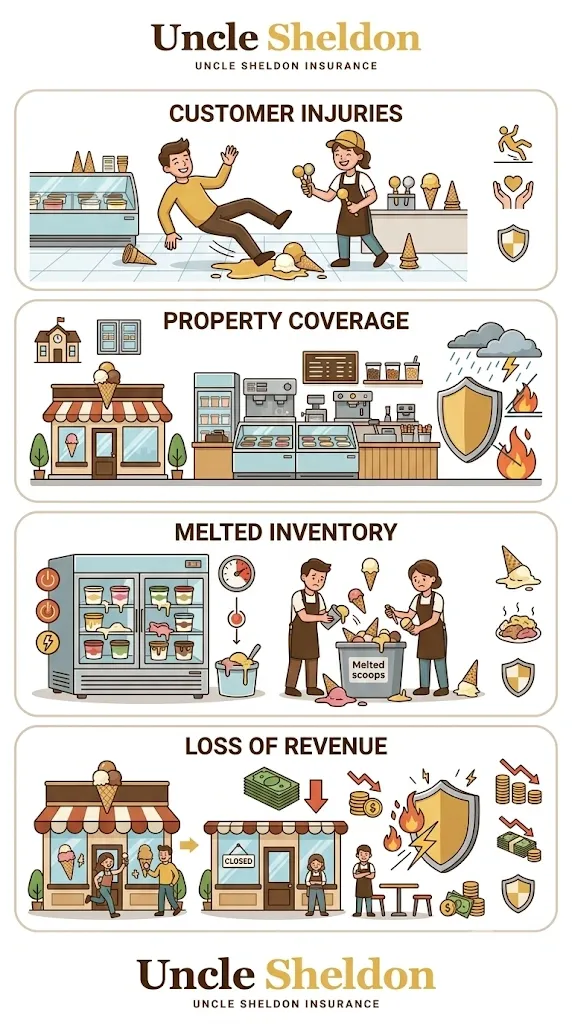
General liability covers third-party bodily injury and property damage claims. Customer slips on a wet floor near the dipping cabinet. A kid trips over a stool and gets hurt. A cone hits someone’s jacket. These are the kinds of incidents that generate liability claims, and general liability is what responds to them.
The foot traffic pattern in an ice cream shop creates genuine slip-and-fall exposure. Ice cream drips. Spills happen constantly. In summer, a busy shop can cycle through a lot of customers in a short window, and the floor conditions in a high-volume ice cream counter are wet more often than not. That exposure is real and the claims do happen.
Commercial property covers your physical assets — the building if you own it, your equipment, your fixtures, your furniture, and your inventory. For an ice cream shop, the equipment side of that can represent a significant investment.
Soft serve machines run anywhere from $5,000 to well over $20,000 depending on the model and configuration. Batch freezers, blast freezers, hardening cabinets, dipping cabinets — a fully equipped shop has a lot of capital tied up in refrigeration and production equipment. Commercial property coverage is what pays to repair or replace those assets after a covered loss like fire, theft, or certain weather damage.
Spoilage Coverage — Non-Negotiable for Ice Cream
This one matters more for ice cream shops than for almost any other retail food business.
If your freezer goes down, or the power goes out, the clock starts running immediately. Ice cream doesn’t hold at rising temperatures the way some other food products might. A few hours without proper refrigeration and you’re looking at a total loss of everything in those cases and cabinets.
Standard commercial property coverage typically excludes spoilage — damage from temperature changes is usually carved out. A spoilage endorsement specifically covers the loss of perishable inventory when refrigeration fails or power is interrupted.
Two things to check carefully when you set this up.
First, make sure the coverage limit actually reflects your peak inventory. A shop that carries thirty-two flavors plus novelty items, pints, and specialty sundae ingredients has a lot more inventory value than the number most people initially estimate. Think about your busiest weekend in July and how stocked your cases are heading into that — that’s the number that should inform your limit.
Second, nail down whether the policy covers off-premises power failures. A lot of basic spoilage endorsements only respond when the power failure originates on your property — a tripped breaker, a blown fuse in your building. If the utility company’s grid goes down and your neighborhood loses power for eight hours, a policy without an off-premises extension might not cover the resulting loss. That distinction is buried in the policy language but it matters enormously. In areas where summer storms regularly knock out power, this coverage needs to follow you off-premises, not just on.
Equipment Breakdown Coverage
Standard commercial property has a gap most shop owners don’t know about until they file a claim. Mechanical and electrical breakdown of the equipment itself is typically excluded from standard property forms. Fire damages the soft serve machine — covered. The machine’s compressor seizes up on its own on the hottest Saturday of the year — probably not, not under a basic property form.
Equipment breakdown coverage closes that gap. It covers the cost to repair or replace equipment that fails due to mechanical or electrical breakdown.
For an ice cream shop, this is essential. Soft serve machines break. Freezer compressors fail. The timing is often terrible — peak summer, weekend rush, right before a big event. Equipment breakdown coverage means that repair bill doesn’t come entirely out of your operating cash, and it can also cover the spoilage that results from the breakdown in coordination with your spoilage endorsement.
Some BOPs include equipment breakdown automatically. Others make it an add-on. Ask specifically when you’re comparing BOP quotes.
Product Liability and Allergen Claims
Ice cream is one of the most allergen-dense foods sold in retail. Dairy, eggs, tree nuts, peanuts, soy, gluten from cones and mix-ins — a single shop may be handling five or six of the nine major federally recognized allergens in the same workspace, often sharing equipment between flavors.
Product liability coverage handles claims arising from your product causing harm to a customer. It sits within the products and completed operations section of your general liability policy, and for a food business it’s the part of the coverage that gets exercised most when something goes wrong.
Allergen cross-contamination claims are where this exposure most commonly shows up for ice cream shops. A customer with a severe peanut allergy orders a flavor that has nothing to do with peanuts. But the scoop used to serve them was also used on a peanut butter cup flavor earlier, and they have a reaction. Or a customer who’s lactose intolerant or has a dairy allergy orders something marketed as dairy-free, but there’s been contamination in the soft serve machine.
These situations happen in real shops. The legal costs alone — regardless of the outcome — can be significant. Product liability coverage is what responds to those claims. Know the sublimits on the products and completed operations section of your policy specifically, because the number there can differ from the overall policy limit.
Careful labeling, dedicated equipment for allergen-free products where you offer them, and clear communication with customers about cross-contamination risk are smart operational practices that also support your insurance position. Some carriers look favorably at shops with documented allergen management procedures.
Business Interruption
This one is worth understanding for any business, but for a seasonal ice cream shop the stakes are amplified.
If your primary equipment fails in July and you’re closed for three weeks waiting on parts and repairs, the commercial property and equipment breakdown coverages handle the repair costs. Business interruption coverage handles the revenue you’re not generating during that closure.
For an ice cream shop that does a meaningful percentage of its annual revenue in a three-month summer window, a three-week closure in peak season isn’t just an inconvenience — it can genuinely change the financial outcome of the entire year. Business interruption coverage replaces the income your business loses during the period when a covered event forces you to suspend operations.
When setting up this coverage, the limit and the benefit period both matter. Make sure the income limit reflects your actual peak revenue, not some conservative estimate, and make sure the covered period is realistic for how long a significant repair or rebuild could actually take.
Workers Compensation
The work environment in an ice cream shop has real injury exposure. Wet floors are the obvious one — employees working behind a counter that’s constantly being wiped down, with customers dripping on the floor, are in a slip hazard environment all day. Burns from waffle cone bakers and waffle bowl makers. Repetitive strain from scooping. Cuts from blenders and equipment cleaning.
Most states require workers’ compensation for businesses with employees, and the requirements vary. Workers’ comp covers an employee’s medical expenses and a portion of their lost wages if they’re hurt on the job. It also provides an exclusive remedy in most states, meaning the injured employee generally can’t bring a separate personal injury lawsuit against you when workers’ comp coverage is in place.
If you have any full-time, part-time, or seasonal staff — and most shops rely heavily on seasonal employees during summer — workers’ comp needs to be part of the conversation.
Ice Cream Trucks and Mobile Operations
The exposure for a mobile ice cream operation is different from a fixed-location shop in a few important ways.
A dedicated ice cream truck needs commercial auto coverage, not personal auto. Personal auto policies exclude commercial use. If you’re in an accident while operating the truck, the personal auto carrier isn’t going to step in — the vehicle was being used as a commercial operation. A commercial auto policy covers the vehicle, the driver, and the liability exposure on the road.
Beyond the auto coverage, mobile food vendors often face licensing requirements from municipalities and event organizers that include specific insurance requirements. A certificate of insurance with a minimum liability limit is a standard ask when you’re applying to operate at a farmers market, festival, or city permit area. Get those requirements before you apply, not after.
The general liability and product liability exposures on a truck are similar to a fixed location, but the property coverage setup differs. Equipment on the truck — the freezers, the generator, the dispensing equipment — needs to be covered, and how that fits into your overall policy structure is worth discussing with an agent who’s familiar with mobile food operations.
Seasonal Operations and Coverage Structure
A lot of ice cream shops close for part of the year, or operate in reduced form during cooler months. This creates a question about how to handle coverage during the off-season.
Most commercial policies don’t automatically pause or reduce premium when a business closes seasonally. But there are ways to structure coverage that reflect the seasonal nature of the operation — particularly around inventory values, which might drop significantly during the off-season.
Vacant or closed properties also have different risk profiles than operating locations. A property that’s unoccupied for months at a time has increased risks around things like vandalism and certain types of property damage. Standard policies often have vacancy clauses that affect coverage after a certain period of non-occupancy.
If your shop closes for several months each year, discuss that with your agent when structuring the policy. There may be ways to align the coverage and the premium with the actual operating calendar.
Alcohol-Infused Products
Boozy ice cream and alcohol-infused treats have become a real segment of the market. If you’re making or selling products with alcohol content, even at the low levels typical of alcohol-infused ice cream, you may need to address that in your coverage.
Whether this creates a liquor liability exposure depends on the alcohol content of the products and how your state classifies them. Most ice cream products with trace alcohol content probably don’t create the same dram shop exposure as a bar serving cocktails. But if you’re offering higher-proof novelty products, getting explicit clarity from your carrier about how those products are treated under your policy is worth doing. Some carriers want to know about it, others don’t, and the answer depends on your state’s laws and the specific products you’re making.
What Drives the Cost
A few factors affect what you’ll pay for ice cream shop coverage.
Revenue and physical size — Higher revenue and more square footage mean more exposure across the board. Premium generally scales with the size of the operation.
Number of employees — More staff means more workers’ comp exposure. Seasonal employees still count.
Location — Urban locations have different property risk profiles than suburban or rural ones. High-crime areas affect property rates. Coastal or weather-exposed locations can affect rates too.
Equipment values — The more expensive and specialized your equipment, the more that factors into the property premium.
Claims history — Prior claims, especially product liability or slip-and-fall claims, push premiums up and can affect market availability.
Seasonal vs. year-round operation — How and when you operate affects how the policy is structured and what’s appropriate in terms of inventory values and property limits.
A Few Things to Check Before You Finalize Coverage
Make sure the equipment values on your policy actually reflect current replacement cost. Soft serve machine prices have increased. If your policy was written a few years ago and you haven’t updated the equipment schedule, you could find yourself underinsured when you need to replace something.
Confirm your spoilage endorsement covers off-premises power failures — ask specifically, don’t assume.
Know the products liability sublimit. For a food business, that’s the section of the policy most likely to get exercised.
If you operate at farmers markets, events, or off-site locations, confirm the policy language covers those activities and isn’t limited to your described premises.
And if you’re planning on adding new flavors or products with significantly different allergen profiles — moving into vegan options, gluten-free cones, nut-based flavors — let your agent know. Significant changes to your product line are worth reporting so your coverage stays accurate.
| Coverage | What It Handles for Ice Cream Shops |
|---|---|
| General liability | Slip-and-fall claims, customer injuries, third-party property damage |
| Commercial property | Equipment, fixtures, inventory, building (if owned) |
| Product liability | Allergen reactions, contamination claims, foreign objects |
| Equipment breakdown | Soft serve machine failure, freezer compressor breakdown |
| Spoilage | Inventory loss from refrigeration failure or power outage |
| Business interruption | Lost revenue during closure from a covered event |
| Workers compensation | Employee injuries on the job |
| Commercial auto | Trucks, delivery vehicles, mobile operations |