
The Coverage Picture Is More Involved Than You Might Expect
Running a bakery sounds straightforward on paper. You make food, sell food, people enjoy it. The insurance picture, though, is a bit more involved than most bakery owners anticipate when they first sit down to put a policy together.
There’s no single product called “bakery insurance” that you buy off a shelf. What you actually end up with is a combination of coverages — some bundled together, some added on separately — that together address the specific things that can go wrong when you’re running a food production business. The combination that makes sense depends a lot on the scale of your operation, whether you deliver, how many employees you have, and a handful of other details.
Here’s a breakdown of what that coverage picture typically looks like and why each piece matters.
The Business Owner’s Policy as a Foundation
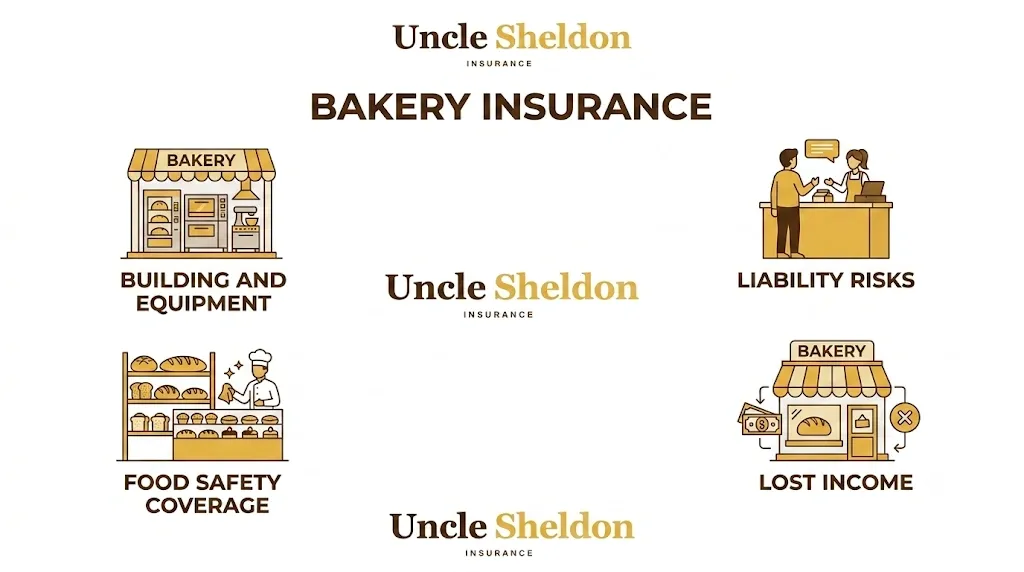
For most small to mid-sized bakeries, the starting point is a Business Owner’s Policy, or BOP. A BOP is a package policy that bundles commercial general liability and commercial property coverage into a single policy, usually at a better price than buying them separately.
The general liability portion covers third-party claims — a customer slips and falls in your shop, someone gets hurt at your premises, a delivery driver trips over your signage out front. It also covers property damage you accidentally cause to someone else’s property. Basic stuff, but it has to be there.
The commercial property portion covers the physical assets of your business — the building if you own it, your equipment, your furniture, your signage, your fixtures, and your inventory. For a bakery, the equipment alone can represent a very significant investment.
A deck oven can run anywhere from $10,000 to $40,000 or more depending on size and configuration. Spiral mixers, proofers, sheeting machines, refrigerated display cases — the capital tied up in production equipment at a functioning bakery adds up fast. The property coverage under your BOP is what replaces or repairs those assets if they’re damaged by a covered peril like fire, theft, or certain weather events.
Product Liability — The One You Cannot Skip
For food businesses, product liability coverage deserves specific attention. It’s technically part of most general liability policies, but understanding exactly what it covers and what the limits are matters more for bakeries than for most businesses.
General liability by itself has limits around what it covers when the harm originates from your product rather than from something that happened on your premises. Product liability — which sits within the products and completed operations section of your GL policy — specifically covers claims arising from a product you made or sold causing harm to someone.
For bakeries, the most common exposures here are allergen-related claims and food contamination.
Allergen claims are real. A customer with a nut allergy has a serious reaction after eating something you labeled as nut-free. A customer with celiac disease gets sick from cross-contamination in a bakery that markets gluten-free items. These situations generate claims, and the legal costs and potential damages can be significant regardless of whether the contamination was accidental or the result of an honest labeling mistake.
The federal allergen labeling requirements were expanded under the FASTER Act, which added sesame as the ninth major allergen starting in January 2023, joining peanuts, tree nuts, milk, eggs, fish, shellfish, wheat, and soy. If you’re making products with multiple ingredients and complex allergen profiles, the labeling risk is ongoing and worth taking seriously.
Food contamination claims — a customer finds a foreign object in a product, or a batch of something makes people sick — are less common but potentially far more serious in terms of financial exposure. Product liability coverage is what responds to these claims. Look at the sublimits on the products and completed operations section of your policy specifically, because that’s where this coverage lives and the numbers can vary.
Equipment Breakdown Coverage
Standard commercial property insurance has a gap that catches bakery owners off guard. It typically excludes damage caused by mechanical or electrical breakdown of the equipment itself. The fire that destroys the oven is covered. The motor that burns out from overloading is probably not — not under a standard property form.
Equipment breakdown coverage fills this gap. It covers the cost to repair or replace equipment that fails due to a mechanical or electrical breakdown rather than an outside cause.
For a bakery, this is genuinely important. Ovens, proofers, refrigeration compressors, industrial mixers — these are complex pieces of equipment that fail. A broken oven at 2 AM before a major weekend order is a serious operational and financial problem. Equipment breakdown coverage means you’re not absorbing that repair cost out of pocket on top of losing the production.
Some BOPs include equipment breakdown coverage automatically. Others offer it as an add-on endorsement. Ask about it specifically when you’re reviewing a BOP quote.
Spoilage Coverage
Bakeries keep perishable inventory — butter, eggs, dairy, fresh fruit fillings, ganache, finished decorated cakes waiting for pickup. If your refrigeration fails or there’s a power outage, that inventory can become worthless in a matter of hours.
Standard commercial property coverage typically excludes damage from temperature changes or spoilage. A spoilage endorsement specifically covers the loss of perishable goods due to refrigeration failure or power interruption.
One thing to pin down: whether the policy covers off-premises power failures. A lot of basic spoilage endorsements only apply to power failures that originate on your property. If the utility company’s substation fails and your block loses power for twelve hours, a policy without an off-premises extension might not respond to the resulting spoilage loss. Clarify this before you buy the coverage, not after you need it.
Business Interruption
If your oven catches fire and you’re closed for six weeks for repairs, your commercial property policy handles the cost of the repairs themselves. But what about the income your bakery isn’t generating during those six weeks? Payroll still runs. Rent is still due.
Business interruption coverage — also called business income coverage — handles the income your business loses during a period when a covered event forces you to stop operating. It’s triggered by the same kinds of events that would cause a property claim, and it covers the income gap during the restoration period.
For bakeries with significant wholesale accounts, standing event orders, or regular corporate clients, a forced closure could mean losing those relationships entirely, not just the immediate revenue. Making sure the business income limits are adequate for your actual revenue — and that the covered period is long enough for a realistic recovery — is worth taking time on when you set up the policy.
Workers Compensation
Bakeries are physically demanding with real injury risks. Burns from ovens and steam equipment, cuts from slicers and scoring tools, repetitive strain from long hours of kneading or shaping, slips on wet kitchen floors — the work environment generates workers’ comp claims with some regularity.
Most states require workers’ compensation coverage for businesses with employees, though the specifics vary. Even in states where you might technically be exempt with only one or two employees, operating without coverage creates significant financial exposure if someone gets injured.
Workers’ comp covers an employee’s medical expenses and a portion of their lost wages for an on-the-job injury. In most states it also functions as an exclusive remedy — meaning an injured employee generally can’t bring a separate lawsuit against you if you carry workers’ comp coverage. That protection alone is worth the premium.
If you have any hourly staff, apprentices, or part-time bakers, make sure workers’ comp is part of your coverage discussion.
Commercial Auto for Delivery Operations
Home delivery and wholesale delivery have become a bigger part of how bakeries operate. If you or an employee uses a vehicle to make deliveries — even occasionally, even in a personal vehicle — you have a commercial auto exposure that a personal auto policy won’t cover.
Personal auto policies typically exclude coverage for commercial use. If you’re in an accident during a delivery run, the personal auto carrier may deny the claim because the vehicle was being used for business purposes. That denial can leave you personally on the hook for a significant loss.
Commercial auto coverage covers vehicles used in business operations, including delivery. If you have a dedicated delivery vehicle, it needs to be on a commercial auto policy. If employees sometimes use their personal vehicles for deliveries, look at hired and non-owned auto coverage, which covers the liability exposure when someone else’s vehicle is used for your business.
Home-Based Bakeries Are a Different Situation
Cottage food laws have expanded across most states over the past decade, and there are a lot of home-based bakeries operating legally under those rules. The insurance situation for home-based operations is different and worth understanding clearly.
A standard homeowner’s or renter’s policy will not cover business activities. If you’re running a bakery out of your home kitchen and a customer has a reaction after eating something you sold them, your homeowner’s policy is very likely going to deny that claim. Business activities are explicitly excluded from standard personal policies.
Home-based bakery owners generally need either a home-based business endorsement added to their homeowner’s policy, a standalone in-home business policy, or a full commercial policy depending on the scale and nature of what they’re doing. Some cottage food operators try to get by with nothing, which is a real and meaningful coverage gap.
Operating within cottage food law limits doesn’t eliminate your insurance exposure — it only defines the regulatory framework. The insurance question is separate from the licensing question.
Farmers Markets, Pop-Ups, and Off-Premises Sales
For bakeries that sell at farmers markets, pop-up events, festivals, or through catering arrangements, the location question matters.
Many standard commercial policies describe a specific premises on the declarations page, and coverage can be limited to that location. If you’re selling at an outdoor market two weekends a month, check whether your policy follows you off-premises or whether you need a specific endorsement or a separate event policy for those sales.
Farmers market organizers and event hosts often also require vendors to carry general liability coverage with a minimum limit and to name the market or event organizer as an additional insured. Get that certificate of insurance squared away before you set up your booth — some markets are strict about this and won’t let you sell without proof.
What Drives the Cost
Bakery insurance premiums depend on several factors.
Revenue — Larger operations with more revenue represent more exposure across the board. Premium generally scales with the size of the business.
Number of employees — More staff means more workers’ comp exposure and a larger overall risk footprint.
Type of products and customers — A bakery specializing in custom allergen-free wedding cakes has a different product liability profile than a standard bread operation. Wholesale bakeries selling to grocery chains carry different exposure than retail storefronts.
Delivery operations — Commercial auto adds to the total cost, and the number of vehicles and drivers affects that portion of the premium.
Claims history — Prior product liability claims or workers’ comp claims push premiums up and can affect what markets are willing to write the coverage.
Location — Urban locations have different property risk profiles than suburban or rural ones. State workers’ comp base rates vary. Property rates reflect local construction costs and weather exposure.
Building characteristics — Whether you own or lease, the age of the building, whether the kitchen has fire suppression, the condition of electrical systems — these all factor into the property premium.
What to Look For When Shopping Coverage
A few things matter when you’re putting together a coverage program for a bakery.
Make sure the equipment values in your policy actually reflect what replacement would cost today. Equipment schedules get stale fast, and if you’ve added ovens, refrigeration, or specialty machines over the years, an outdated schedule can leave you significantly underinsured when you need to file a claim.
Look at the business income section carefully — specifically how long the coverage extends and whether there are sublimits or time caps on the benefit period. Six weeks of covered income loss might not be enough if a significant fire closes you for four months.
Ask specifically about the products and completed operations sublimit within your general liability policy, not just the overall policy limit. They can differ, and for a food business the products portion is where your real exposure sits.
If you’re doing any wholesale business or supplying products to other retailers, check whether any of your buyers require product recall coverage or additional insured status on your policy. Grocery chains and wholesale food buyers sometimes ask for specific requirements as a condition of doing business.
And if your business model involves pop-ups, catering partnerships, or off-premises events, confirm the policy language covers those activities rather than assuming coverage follows you wherever you go.
| Coverage Type | What It Addresses for Bakeries |
|---|---|
| Commercial property | Equipment, building, inventory, fixtures |
| General liability | On-premises injuries, third-party property damage |
| Product liability | Allergen reactions, contamination claims, foreign objects |
| Equipment breakdown | Mechanical/electrical failure of ovens, mixers, coolers |
| Spoilage | Perishable inventory lost to refrigeration failure or power outage |
| Business interruption | Income loss during closure from a covered event |
| Workers compensation | Employee injuries on the job |
| Commercial auto | Delivery vehicles and drivers |