
Coverage for the Most Vulnerable Phase of a Building’s Life
From the day ground breaks to the day construction is complete, a building under construction occupies a strange insurance territory. It’s not finished, so a standard commercial property policy won’t touch it. The materials on the job site aren’t stored in a building that’s covered. Workers are coming and going. The structure is exposed to weather, theft, and all kinds of accidental damage in ways a finished building simply isn’t.
Builder’s risk insurance — sometimes called course of construction insurance — is the coverage specifically designed for this period. It insures structures while they’re being built, along with the materials and equipment that go into them. Once the building is finished and occupied, the coverage ends and a standard property policy takes over.
Understanding how builder’s risk actually works — what it covers, who buys it, what it excludes, and how policies are structured — matters a lot before you start a project. Discovering the gaps after a loss is a considerably worse time to learn.
Who Typically Buys the Policy
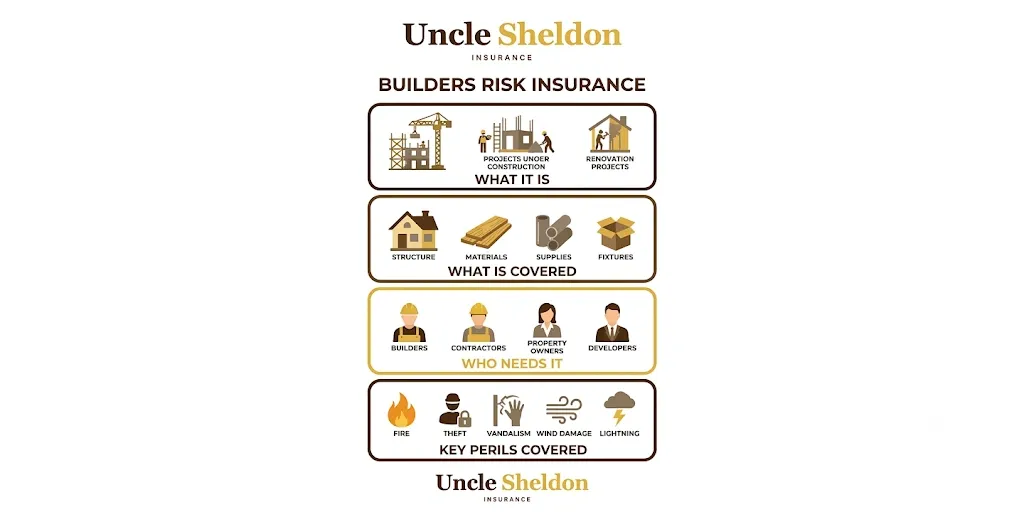
This depends on how the project is structured and what the contract says. There’s no universal rule about whether the property owner or the general contractor purchases the builder’s risk policy. Both scenarios are common, and in larger projects it’s sometimes negotiated explicitly in the construction contract.
Property owners and developers often purchase builder’s risk for commercial developments, residential new builds they’re funding, and major renovation projects. When the owner is also the one carrying the financial risk of the project, buying the policy themselves gives them direct control over the coverage.
General contractors frequently purchase builder’s risk for projects where they’re taking on significant responsibility under the contract. Some general contractors purchase it as a standard part of doing business, either building the cost into the project price or carrying a rolling builders risk policy that covers multiple jobs under one policy.
Lenders sometimes require builder’s risk as a condition of a construction loan. A bank financing a development isn’t going to advance draws against a project with no coverage for the structure going up.
Whoever buys it, the policy should typically be structured to cover all parties with an insurable interest in the project — the owner, the general contractor, and often subcontractors. A well-written builder’s risk policy names the relevant parties so there’s no dispute about who can make a claim if something goes wrong.
What Builder’s Risk Actually Covers
A builder’s risk policy covers the structure being built along with materials, fixtures, and equipment intended to become part of that structure. Think of it as covering the physical stuff of the project — what’s going up, what’s been delivered to the site, and what’s in transit to the site.
The structure itself — The building or addition under construction, including temporary structures like forms, scaffolding, and falsework that are part of the construction process.
Materials and supplies on-site — Lumber, framing, roofing materials, windows, doors, cabinets, plumbing fixtures, electrical components, and everything else that’s been delivered and is sitting on the job site waiting to be installed. Materials that get stolen or damaged by a covered peril before they go into the building are covered.
Materials in transit — Most policies extend coverage to materials in transit to the job site, up to a certain limit. If a delivery truck carrying $30,000 worth of windows is involved in an accident and the windows are destroyed, a well-written builder’s risk policy covers that.
Materials stored temporarily off-site — Materials being stored at a warehouse or staging area before delivery can sometimes be covered as well, though the terms and limits for off-site storage vary by policy and should be reviewed specifically.
Foundations — Coverage typically applies to foundations once they’re in the ground. Some policies have specific language around whether underground work is included, so it’s worth confirming.
The covered perils in a builder’s risk policy are typically broad — fire, windstorm, lightning, hail, vandalism, theft, and in some cases water damage, collapse, and other events. Policies are often written on an “open perils” or “all-risk” basis, which means everything is covered unless specifically excluded, rather than a named-perils basis where only listed causes of loss apply.
What Builder’s Risk Doesn’t Cover
The exclusions matter a lot in builder’s risk, and some of them surprise people.
Faulty design, workmanship, or materials — If a contractor installs something incorrectly and it fails, the resulting damage to that work itself isn’t covered. Builder’s risk is not a warranty for construction quality. The damage caused by a faulty pipe that bursts and floods finished space might be covered, but the cost of redoing the faulty installation is not. This distinction — the faulty work versus the resulting damage — comes up in claims fairly often.
Employee theft — Theft of materials by the contractor’s own employees is typically excluded. This is a separate crime coverage issue and not what builder’s risk is designed for.
Mechanical breakdown — If a piece of equipment fails due to mechanical reasons, that’s not a builder’s risk claim.
Flood and earthquake — Like most property policies, standard builder’s risk excludes flood and earthquake damage. Flood coverage through the National Flood Insurance Program or a private flood carrier would need to be arranged separately. Earthquake coverage, where available, requires a separate policy or specific endorsement.
Wind-driven rain causing damage through an opening — This one trips people up. If rain gets into a building through an opening that hasn’t been properly protected — say, a roof that’s not yet sheathed — some policies have exclusions or conditions around this. Making sure the building is reasonably secured against the elements as work progresses is both good practice and sometimes a policy requirement.
Tools and equipment owned by contractors — Builder’s risk covers the materials going into the building. It does not cover the contractor’s tools, machinery, and mobile equipment. Those are covered under what’s called an inland marine policy, specifically a contractors equipment floater or installation floater, which is a separate coverage.
Liability — Builder’s risk is property coverage. It does not cover bodily injury or property damage claims from third parties. That’s what general liability and workers’ compensation are for, and every contractor on a job site should have both.
Existing structures — On renovation projects, the existing structure that’s already in place before construction begins may or may not be covered under the builder’s risk policy. This needs to be specifically addressed when you’re buying coverage for a renovation, and in many cases the existing structure requires a separate property policy or a specific endorsement.
Soft Costs Coverage — The Piece Most People Miss
A standard builder’s risk policy covers the physical project. What it usually doesn’t cover unless you specifically add it is the indirect financial loss that comes when a major loss extends your construction timeline.
These indirect costs are called soft costs, and they can be substantial.
When a job site fire sets a commercial project back four months, the physical damage is one thing. But the developer is also facing:
- Additional loan interest on the construction financing for those four months
- Extended permits, architect fees, and engineering fees to rebuild or redesign
- Real estate taxes and insurance premiums on the property during the extended period
- Lost rental income or lost revenue from a business that was supposed to open
Soft costs coverage is an endorsement or separate coverage layer that picks up these kinds of indirect losses. It’s particularly relevant for commercial projects and any project where there’s a business or revenue stream dependent on the building opening on schedule.
Not every project needs soft costs coverage. A homeowner building a personal residence doesn’t have the same exposure as a developer building a retail center. But for commercial projects, it’s a coverage worth specifically asking about.
How the Policy Period Works
Builder’s risk policies run for a defined period — often 6, 12, or 18 months, depending on the anticipated construction timeline. The coverage begins when construction starts and is intended to end when the project is substantially complete.
The definition of “substantially complete” varies. For most policies, coverage ends when:
- The building is complete and ready for occupancy
- The building is actually occupied, even partially
- The policy term expires
- The insured takes possession of the property for its intended use
That last bullet point matters for renovation projects. If a property owner takes possession of sections of a renovation that have been completed while other areas are still under construction, coverage on the completed sections may terminate under some policy language.
If construction runs over schedule and the policy term is about to expire before the project is done, most carriers will extend the policy — usually for an additional premium. This should be handled before the expiration date, not after.
One important thing to know: coverage typically doesn’t begin the moment you buy the policy. It begins when construction actually starts. If you buy a builder’s risk policy and then there’s a six-week delay before breaking ground, the clock on the policy typically doesn’t start until work begins. The mechanics of this vary by carrier and policy, so it’s worth confirming.
Coverage Limits and How the Project Gets Valued
The coverage limit on a builder’s risk policy should equal the completed value of the project — not just the current value at the time of purchase. This is different from the way property policies work for existing structures.
Here’s why: if a building that would be worth $2 million when complete burns down in month four when it’s only 40% finished, the cost to get back to that same point isn’t 40% of $2 million. You’ve got to remove the debris, start over, and build again. The materials, labor, and timeline have to be covered appropriately.
The way most builder’s risk policies handle this is that the limit is set at the completed value from the start. You’re not insuring what’s currently in place — you’re insuring what the completed project is going to cost.
For large projects, updating the policy as the project scope changes is important. If a project expands significantly in scope mid-construction and the original policy limit no longer reflects the completed value, you’re underinsured.
| Valuation Basis | How It’s Used |
|---|---|
| Completed project value | Standard — coverage set at what the building will cost when done |
| Actual cash value | Less common; accounts for depreciation, generally not appropriate for new construction |
| Replacement cost | Relevant for renovation projects where existing structure is included |
What Affects the Premium
Builder’s risk premiums are usually calculated as a percentage of the completed project value. Rates vary based on the type of project, the construction methods and materials, the location, the duration, and the carrier.
Type of construction — Wood frame construction is more flammable and generally more expensive to insure than steel or masonry. A wood-frame apartment building has a different risk profile than a concrete parking structure.
Location — Projects in areas with high wind risk, flood risk, or high crime are rated differently than projects in lower-exposure areas. Coastal construction in hurricane-prone states gets close attention.
Project duration — Longer projects mean longer exposure, which generally means higher total premium.
Security measures — A job site with perimeter fencing, cameras, and an alarm system is a better risk than one with open access.
Contractor experience and track record — Some carriers look at the general contractor’s experience and loss history as part of the underwriting.
Type of project — Residential new construction, commercial new construction, renovation, and tenant improvement projects are each underwritten somewhat differently.
Rough range for context: builder’s risk premiums often run somewhere in the range of 1% to 4% of the completed project value annually, but this varies considerably based on all the factors above. Getting actual quotes from carriers who specialize in construction is the only reliable way to know what a specific project will cost.
Renovation Projects — A More Complicated Picture
New construction is relatively straightforward for builder’s risk — the policy covers what’s being built from the ground up. Renovation projects introduce complications because you have an existing structure that you’re modifying.
The questions that need to be sorted out for a renovation project:
Is the existing structure covered? If a fire destroys part of an existing building you’re renovating, does the builder’s risk policy cover the damage to the pre-existing structure, or only the new construction? The answer depends on whether the existing structure is specifically included in the policy — and in many standard policies, it isn’t unless it’s been added.
What counts as the renovation value? Setting the limit is trickier when you’re adding to an existing building rather than building one from scratch.
Who has the standard property policy? If the owner has an existing commercial property policy on the building and is doing a renovation, there needs to be coordination between that policy and the builder’s risk policy so claims don’t fall into gaps between the two.
The short version is that renovations need more careful attention during the coverage setup than new construction does. The details have to be right.
Builder’s Risk vs. General Liability — Knowing the Difference
These two coverages are often bought together for a construction project, but they cover entirely different things.
Builder’s risk is property coverage. It covers physical damage to the project itself. If a windstorm takes out a partially completed roof, that’s a builder’s risk claim.
General liability covers the contractor’s legal liability for bodily injury and property damage to third parties. If a subcontractor’s work causes a water pipe to fail and damages a neighboring business, that’s a general liability claim. If a visitor to the job site is injured because of a hazard on the premises, that’s a general liability claim.
Both coverages are essential on a construction project. They address completely different exposures and one doesn’t substitute for the other.
Inland Marine Coverage — Tools and Equipment
A note on a related type of coverage that often gets discussed alongside builder’s risk:
Installation floaters cover materials and equipment in transit to and from a job site, and during the installation process. This is sometimes included within a builder’s risk policy but can also be written as a standalone inland marine policy.
Contractors equipment floaters cover the contractor’s own tools, machinery, and mobile equipment — compressors, generators, ladders, power tools, excavators. These items have significant value and are frequently stolen from job sites, but they’re not part of the building being constructed, so builder’s risk doesn’t cover them.
If you’re a contractor running jobs regularly, a contractors equipment floater is worth having in addition to builder’s risk. It covers the tools you need to do the work, not just the project itself.
Subcontractors and Who’s Actually Covered
A builder’s risk policy typically names the property owner and general contractor. Whether subcontractors are covered as additional insureds — or whether the policy covers their work product — varies.
Some policies automatically extend coverage to subcontractors working on the project. Others require subcontractors to be specifically listed or provide their own coverage. In many contracts, subcontractors are required to maintain their own general liability and other coverages, and the builder’s risk is coordinated with those policies to avoid duplication or gaps.
The way coverage applies to subcontractor-caused losses is worth understanding before a claim occurs, not during one. If a subcontractor’s mistake causes a fire or a flood in a partially finished building, knowing which policy responds and how depends entirely on how the policies are written and coordinated.
Common Claims on Builder’s Risk Policies
To give a concrete sense of how this coverage actually responds:
Fire — Job site fires are a real and frequent cause of loss. Combustible materials, temporary electrical, heaters used in cold weather, cutting and welding operations — construction sites have significant fire exposure. A fire in a framed but unclad structure can take the whole building.
Theft of materials — Copper, electrical equipment, HVAC equipment, appliances — materials staged on a job site or left in a partially completed building are theft targets. Builder’s risk theft coverage addresses this.
Wind damage — An unfinished structure is more vulnerable to wind than a completed one. A heavy windstorm during framing can cause significant structural damage before walls and roofing are in place to stabilize everything.
Water intrusion — Rain, storm runoff, and plumbing failures in new construction can damage materials and delay the project. How water damage is covered depends on the source of the water and the specific policy language.
Collapse — Partial structural collapses during construction, whether from soil conditions, foundation issues, or improper shoring, are a builder’s risk concern.
Vandalism — Job sites that are unsecured overnight or on weekends are targets for vandalism, particularly in urban areas.
The Importance of Getting It Right Before Breaking Ground
The time to set up builder’s risk coverage is before construction starts, not after something happens. Trying to add coverage after a loss has already occurred — or discovering that coverage lapsed because the project ran longer than the policy term — creates problems that are difficult to resolve favorably.
For project owners, understanding what the policy covers and confirming that the limit reflects the true completed project value is the baseline. For contractors, knowing whether the owner is buying the policy or whether you’re responsible for it — and verifying that before the first nail goes in — is essential. And for anyone involved in a project, making sure the coordination between builder’s risk, general liability, and any existing property coverage on the site is clean prevents claims from falling into the gaps.